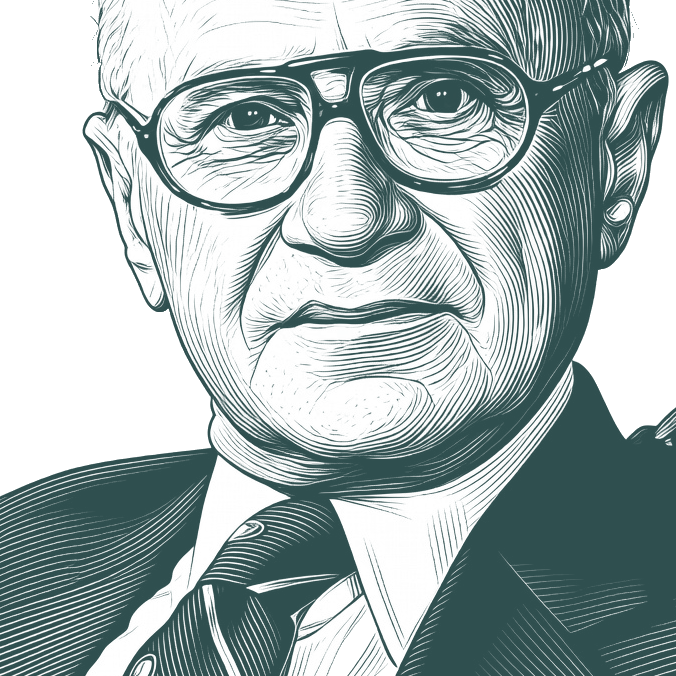
That is a widespread myth, that it is possible to spend money with nobody paying for it. You have everybody screaming that we ought to have new, bigg… - Milton Friedman
""
That is a widespread myth, that it is possible to spend money with nobody paying for it. You have everybody screaming that we ought to have new, bigger, more generous government programs. Where are we going to raise the money? Tax business. But business corporations can’t pay any taxes. A corporate executive may sign the check, but where does he get the money? From his stockholders or from his customers or from his employees. Unlike the federal government, he doesn’t have a printing press in his basement. So the only way he can pay money to the government is imposing a burden on somebody. Government cannot spend money at nobody’s expense.
English
Collect this quote
About
Milton Friedman
Milton Friedman (31 July 1912 – 16 November 2006) was an American economist noted for his support for free markets and a reduction in the size of government. In 1976 he was awarded a Nobel Prize in Economics.
Biography information from
Wikiquote·
Portrait adapted from
Wikimedia Commons, Bachrach Studios (Public domain / CC0)
(1) The church-state issue. If parents could use their vouchers to pay tuition at parochial schools, would that violate the First Amendment? Whether it does or not, is it desirable to adopt a policy that might strengthen the role of religious institutions in schooling? The Supreme Court has generally ruled against state laws providing assistance to parents who send their children to parochial schools, although it has never had occasion to rule on a full-fledged voucher plan covering both public and nonpublic schools. However it might rule on such a plan, it seems clear that the Court would accept a plan that excluded church-connected schools but applied to all other private and public schools. Such a restricted plan would be far superior to the present system, and might not be much inferior to a wholly unrestricted plan. Schools now connected with churches could qualify by subdividing themselves into two parts: a secular part reorganized as an independent school eligible for vouchers, and a religious part reorganized as an after-school or Sunday activity paid for directly by parents or church funds. The constitutional issue will have to be settled by the courts. But it is worth emphasizing that vouchers would go to parents, not to schools. Under the GI bills, veterans have been free to attend Catholic or other colleges and, so far as we know, no First Amendment issue has ever been raised. Recipients of Social Security and welfare payments are free to buy food at church bazaars and even to contribute to the collection plate from their government subsidies, with no First Amendment question being asked. Indeed, we believe that the penalty that is now imposed on parents who do not send their children to public schools violates the spirit of the First Amendment, whatever lawyers and judges may decide about the letter. Public schools teach religion, too — not a formal, theistic religion, but a set of values and beliefs that constitute a religion in all but name. The prese
Go Premium
Support Quotewise while enjoying an ad-free experience and premium features.
There is all the difference in the world, however, between two kinds of assistance through government that seem superficially similar: first, 90 percent of us agreeing to impose taxes on ourselves in order to help the bottom 10 percent, and second, 80 percent voting to impose taxes on the top 10 percent to help the bottom 10 percent — William Graham Sumner's famous example of B and C deciding what D shall do for A.