Your wonderment 'what I have against religion' reminds me of your recent Vagrant essay . . . To my mind, that essay misses one point altogether. Your… - H. P. Lovecraft
""
Your wonderment 'what I have against religion' reminds me of your recent Vagrant essay . . . To my mind, that essay misses one point altogether. Your "agnostic" has neglected to mention the very crux of all agnosticism—namely that the Judaeo-Christian mythology is NOT TRUE. I can see that in your philosophy truth per se has so small a place, that you can scarcely realise what it is that Galpin and I are insisting upon. In your mind, MAN is the centre of everything, and his exact conformation to certain regulations of conduct HOWEVER EFFECTED, the only problem in the universe. Your world (if you will pardon my saying so) is contracted. All the mental vigour and erudition of the ages fail to disturb your complacent endorsement of empirical doctrines and purely pragmatical notions, because you voluntarily limit your horizon—excluding certain facts, and certain undeniable mental tendencies of mankind. In your eyes, man is torn between only two influences; the degrading instincts of the savage, and the temperate impulses of the philanthropist. To you, men have but two types of emotion—lovers of the self and lovers of the race. . . . You are forgetting a human impulse which, despite its restriction to a relatively small number of men, has all through history proved itself as real and as vital as hunger—as potent as thirst or greed. I need not say that I refer to that simplest yet most exalted attribute of our species—the acute, persistent, unquenchable craving TO KNOW. Do you realise that to many men it makes a vast and profound difference whether or not the things about them are as they appear? . . . If TRUTH amounts to nothing, then we must regard the phantasma of our slumbers just as seriously as the events of our daily lives. . . . I recognise a distinction between dream life and real life, between appearances and actualities. I confess to an over-powering desire to know whether I am asleep or awake—whether the environment and laws which affect me are external and permanent, or the transitory products of my own brain. I admit that I am very much interested in the relation I bear to the things about me—the time relation, the space relation, and the causative relation. I desire to know approximately what my life is in terms of history—human, terrestrial, solar, and cosmical; what my magnitude may be in terms of extension,—terrestrial, solar, and cosmical; and above all, what may be my manner of linkage to the general system—in what way, through what agency, and to what extent, the obvious guiding forces of creation act upon me and govern my existence. And if there be any less obvious forces, I desire to know them and their relation to me as well.
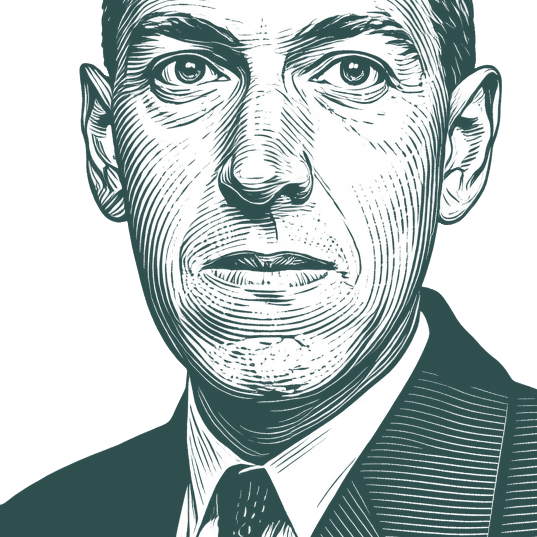
Howard Phillips Lovecraft (20 August 1890 – 15 March 1937) was an American author of fantasy, horror, and science fiction, known for combining these three genres within single narratives and best remembered for the creation of the Cthulhu Mythos. He is considered, along with Edgar Allan Poe, to be one of the greatest Horror writers.
Biography information from
Wikiquote·
Portrait adapted from
Wikimedia Commons, Lucius B. Truesdell (Public domain / CC0)
Also Known As
Pen Names:
Ward Phillips
Native Name:
Howard Phillips Lovecraft
Alternative Names:
Howard P. Lovecraft
•
HPL
•
E'ch-Pi-El
•
Grandpa Theobald
•
Lovecraft
I am perfectly confident that I could never adequately convey to any other human being the precise reasons why I continue to refrain from suicide—the reasons, that is, why I still find existence enough of a compensation to atone for its dominantly burthensome quality. These reasons are strongly linked with architecture, scenery, and lighting and atmospheric effects, and take the form of vague impressions of adventurous expectancy coupled with elusive memory—impressions that certain vistas, particularly those associated with sunsets, are avenues of approach to spheres or conditions of wholly undefined delights and freedoms which I have known in the past and have a slender possibility of knowing again in the future. Just what those delights and freedoms are, or even what they approximately resemble, I could not concretely imagine to save my life; save that they seem to concern some ethereal quality of indefinite expansion and mobility, and of a heightened perception which shall make all forms and combinations of beauty simultaneously visible to me, and realisable by me. I might add, though, that they invariably imply a total defeat of the laws of time, space, matter, and energy—or rather, an individual independence of these laws on my part, whereby I can sail through the varied universes of space-time as an invisible vapour might ... upsetting none of them, yet superior to their limitations and local forms of material organisation. ... Now this all sounds damn foolish to anybody else—and very justly so. There is no reason why it should sound anything except damn foolish to anyone who had not happened to receive precisely the same series of inclinations, impressions, and background-images which the purely fortuitous circumstances of my own especial life have chanced to give me.
And at last I resolved to scale that tower, fall though I might; since it were better to glimpse the sky and perish, than to live without ever beholding day.
Enhance Your Quote Experience
Enjoy ad-free browsing, unlimited collections, and advanced search features with Premium.