Every book of tactics in the regiment was in use from morning until night, and the officers and non-commissioned officers were always studying the pr… - Theodore Roosevelt
""
Every book of tactics in the regiment was in use from morning until night, and the officers and non-commissioned officers were always studying the problems presented at the schools.
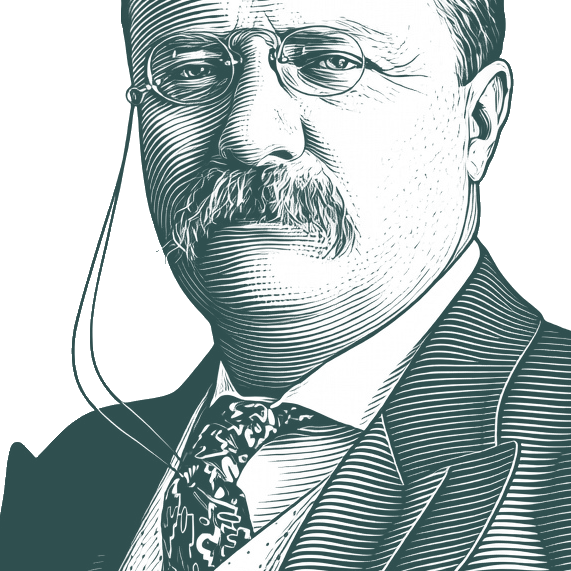
Theodore Roosevelt, Jr. (27 October 1858 – 6 January 1919), also known as T.R. or Teddy, was an American statesman, author, explorer, soldier, naturalist, and reformer who served as the 26th president of the United States from 1901 to 1909. As a leader of the Republican Party during this time, he became a driving force for the Progressive Era in the United States in the early 20th century.
Biography information from
Wikiquote·
Portrait adapted from
Wikimedia Commons, Adam Cuerden (Public domain / CC0)
Also Known As
Birth Name:
Theodore Roosevelt Jr.
Also Known As:Teddy
Alternative Names:
Teddy Roosevelt
•
Theodore Roosevelt, Jr.
•
T. Roosevelt
•
T. Roosevelt, Jr.
•
T. R.
We cannot avoid meeting great issues. All that we can determine for ourselves is whether we shall meet them well or ill.
...If there is not the war, you don't get the great general; if there is not the great occasion, you don't get the great statesman; if Lincoln had lived in times of peace, no one would know his name now.
Limited Time Offer
Premium members can get their quote collection automatically imported into their Quotewise collections.
there were certain crimes where requests for leniency merely made me angry. Such crimes were, for instance, rape, or the circulation of indecent literature, or anything connected with what would now be called the “white slave” traffic, or wife murder, or gross cruelty to women and children, or seduction and abandonment, or the action of some man in getting a girl whom he had seduced to commit abortion. I am speaking in each instance of cases that actually came before me, either while I was governor or while I was president. In an astonishing number of these cases men of high standing signed petitions or wrote letters asking me to show leniency to the criminal. In two or three of the cases — one where some young roughs had committed rape on a helpless immigrant girl, and another in which a physician of wealth and high standing had seduced a girl and then induced her to commit abortion — I rather lost my temper, and wrote to the individuals who had asked for the pardon, saying that I extremely regretted that it was not in my power to increase the sentence. I then let the facts be made public, for I thought that my petitioners deserved public censure. Whether they received this public censure or not I did not know, but that my action made them very angry I do know, and their anger gave me real satisfaction.