Because when she failed, I saw how she might have succeeded. Arrows that continually glanced off from Mr. Rochester's breast and fell harmless at his… - Charlotte Brontë
""
Because when she failed, I saw how she might have succeeded. Arrows that continually glanced off from Mr. Rochester's breast and fell harmless at his feet, might, I knew, if shot by a surer hand, have quivered keen in his proud heart - have called love into his stern eye, and softness into his sardonic face, or better still, without weapons a silent conquest might have been won.
English
Collect this quote
About
Charlotte Brontë
Charlotte Brontë (21 April 1816 – 31 March 1855) was an English novelist, the eldest of the three Brontë sisters, who first published her work under the pseudonym Currer Bell.
Biography information from
Wikiquote·
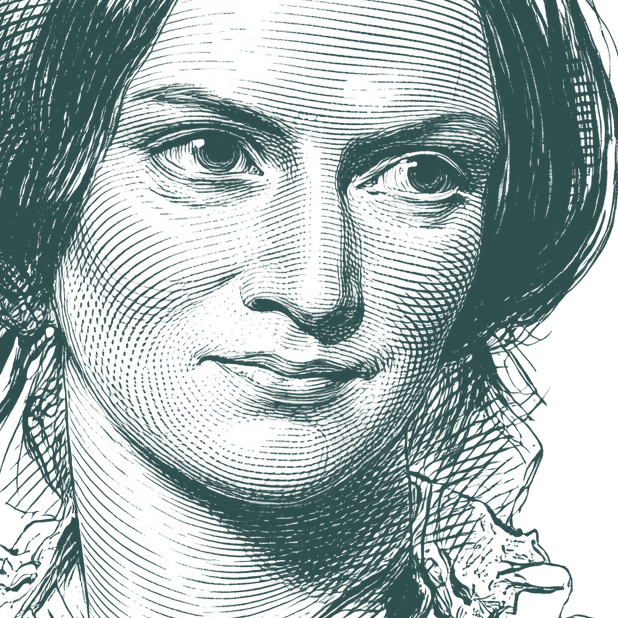
Portrait adapted from
Wikimedia Commons, George Richmond (Public domain / CC0)
Also Known As
Alternative Names:
Tree
•
Florian Wellesley
•
Lord Charles Albert
•
Captain Tree
•
Charles Wellesley
•
Charlotte Bronte
•
Currer Bell
•
Karlotta Bronte
•
Douro
•
Mrs. A. B. Nicholls
•
Charlotte Nicholls
•
Sharlotta Bronte
•
Mrs. Arthur Bell NichollsMrs. Arthur Bell Nicholls
Emily suffers no more from pain or weakness now. She will never suffer more in this world. She is gone after a hard, short conflict...Yes there is no Emily in time or on earth now. Yesterday we put her poor, wasted, mortal frame quietly under the chancel pavement. We are very calm at present. Why shoud we be otherwise? The anguish of seeing her suffer is over; the spectacle of the pains of death is gone by; the funeral day is past. We feel she is at peace. No need now to trouble for the hard frost and the keen wind. Emily does not feel them.
I have a strange feeling with regard to you. As if I had a string somewhere under my left ribs, tightly knotted to a similar string in you. And if you were to leave I'm afraid that cord of communion would snap. And I have a notion that I'd take to bleeding inwardly. As for you, you'd forget me.
Unlimited Quote Collections
Organize your favorite quotes without limits. Create themed collections for every occasion with Premium.
Impatiently I waited for evening, when I might summon you to my presence. An unusual– to me– a perfectly new character, I suspected was yours; I desired to search it deeper, and know it better. You entered the room with a look and air at once shy and independent; you were quaintly dress– much as you are now. I made you talk; ere long I found you full of strange contrasts. Your garb and manner were restricted by rule; your air was often diffident, and altogether that of one refined by nature, but absolutely unused to society, and a good deal afraid of making herself disadvantageously conspicuous by some solecism or blunder; yet, when addressed, you lifted a keen, a daring, and a glowing eye to your interlocutor’s face; there was penetration and power in each glance you gave; when plied by close questions, you found ready and round answers. Very soon you seemed to get used to me – I believe you felt the existence of sympathy between you and your grim and cross master, Jane; for it was astonishing to see how quickly a certain pleasant ease tranquilized your manner; snarl as I would, you showed no surprise, fear, annoyance, or displeasure, at my moroseness; you watched me, and now and then smiled at me with a simple yet sagacious grace I cannot describe. I was at once content and stimulated with what I saw; I liked what I had seen, and wished to see more. Yet, for a long time, I treated you distantly, and sought your company rarely, I was an intellectual epicure, and wished to prolong the gratification of making this novel and piquant acquaintance; besides, I was for a while troubled with a haunting fear that if I handled the flower freely its bloom would fade – the sweet charm of freshness would leave it. I did not then know that it was no transitory blossom, but rather the radiant resemblance of one, cut in an indestructible gem. Moreover, I wished to see whether you would seek me if I shunned you – but you did not; you kept in the school-room as still as your own des