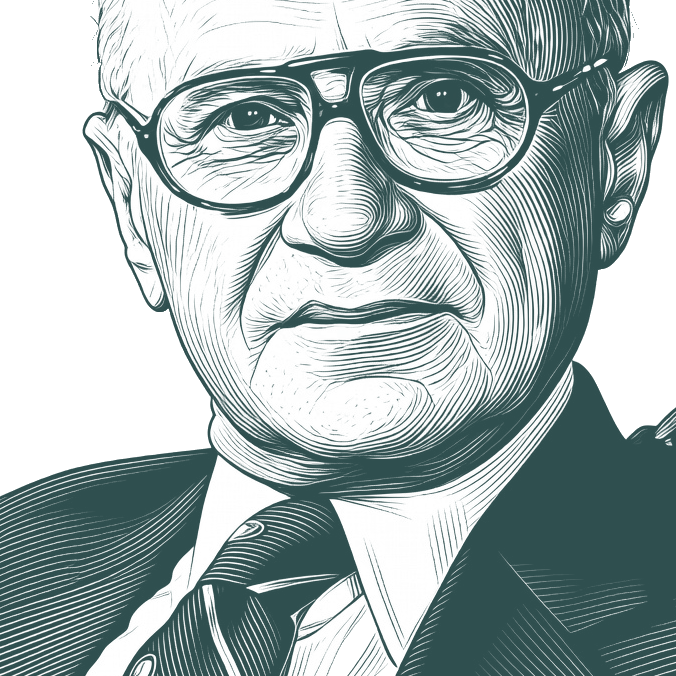
Only a crisis - actual or perceived - produces real change. When that crisis occurs, the actions that are taken depend on the ideas that are lying ar… - Milton Friedman
""
Only a crisis - actual or perceived - produces real change. When that crisis occurs, the actions that are taken depend on the ideas that are lying around. That, I believe, is our basic function: to develop alternatives to existing policies, to keep them alive and available until the politically impossible becomes the politically inevitable.
English
Collect this quote
About
Milton Friedman
Milton Friedman (31 July 1912 – 16 November 2006) was an American economist noted for his support for free markets and a reduction in the size of government. In 1976 he was awarded a Nobel Prize in Economics.
Biography information from
Wikiquote·
Portrait adapted from
Wikimedia Commons, Bachrach Studios (Public domain / CC0)
People who intend to serve only the public interest are led by an invisible hand to serve private interests which was no part of their intention.
A thoroughgoing paternalist who holds it cannot be dissuaded by being shown that he is making a mistake in logic. He is our opponent on grounds of principle, not simply a well-meaning but misguided friend. Basically, he believes in dictatorship, benevolent and maybe majoritarian, but dictatorship none the less. Those of us who believe in freedom must believe also in the freedom of individuals to make their own mistakes. If a man knowingly prefers to live for today, to use his resources for current enjoyment, deliberately choosing a penurious old age, by what right do we prevent him from doing so? We may argue with him, seek to persuade him that he is wrong, but are we entitled to use coercion to prevent him from doing what he chooses to do? Is there not always the possibility that he is right and that we are wrong? Humility is the distinguishing virtue of the believer in freedom; arrogance, of the paternalist.
Enhance Your Quote Experience
Enjoy ad-free browsing, unlimited collections, and advanced search features with Premium.
Those of us who believe in freedom must believe also in the freedom of individuals to make their own mistakes. If a man knowingly prefers to live for today, to use his resources for current enjoyment, deliberately choosing a penurious old age, by what right do we prevent him from doing so?