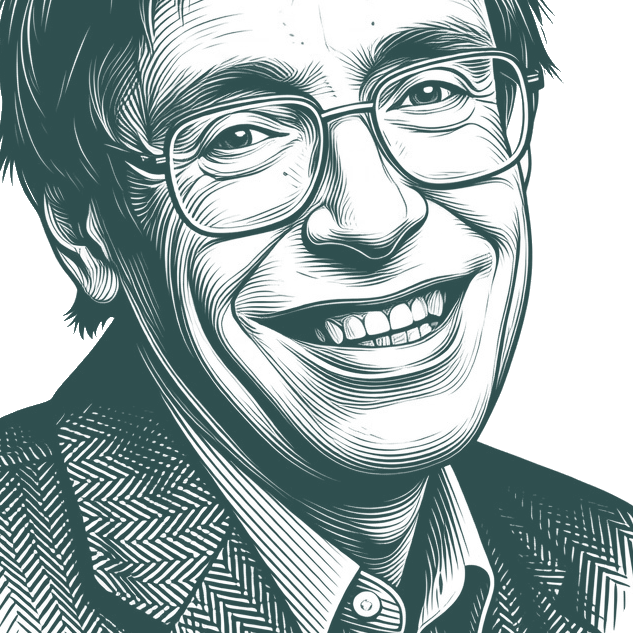
If you are disabled, it is probably not your fault, but it is no good blaming the world or expecting it to take pity on you. One has to have a positi… - Stephen Hawking
""
If you are disabled, it is probably not your fault, but it is no good blaming the world or expecting it to take pity on you. One has to have a positive attitude and must make the best of the situation that one finds oneself in; if one is physically disabled, one cannot afford to be psychologically disabled as well. In my opinion, one should concentrate on activities in which one's physical disability will not present a serious handicap. I am afraid that Olympic Games for the disabled do not appeal to me, but it is easy for me to say that because I never liked athletics anyway. On the other hand, science is a very good area for disabled people because it goes on mainly in the mind. Of course, most kinds of experimental work are probably ruled out for most such people, but theoretical work is almost ideal. My disabilities have not been a significant handicap in my field, which is theoretical physics. Indeed, they have helped me in a way by shielding me from lecturing and administrative work that I would otherwise have been involved in. I have managed, however, only because of the large amount of help I have received from my wife, children, colleagues and students. I find that people in general are very ready to help, but you should encourage them to feel that their efforts to aid you are worthwhile by doing as well as you possibly can.
Stephen William Hawking CH CBE FRS (8 January 1942 - 14 March 2018) was a British theoretical physicist, cosmologist, author and Director of Research at the Centre for Theoretical Cosmology within the University of Cambridge.
Biography information from
Wikiquote·
Portrait adapted from
Wikimedia Commons, NASA (Public domain / CC0)
Also Known As
Native Name:
Stephen William Hawking
Alternative Names:
Hawking
•
S. W. Hawking
•
stephen
•
S. Hawking
The ultimate objective test of free will would seem to be: Can one predict the behavior of the organism? If one can, then it clearly doesn't have free will but is predetermined. On the other hand, if one cannot predict the behavior, one could take that as an operational definition that the organism has free will … The real reason why we cannot predict human behavior is that it is just too difficult. We already know the basic physical laws that govern the activity of the brain, and they are comparatively simple. But it is just too hard to solve the equations when there are more than a few particles involved … So although we know the fundamental equations that govern the brain, we are quite unable to use them to predict human behavior. This situation arises in science whenever we deal with the macroscopic system, because the number of particles is always too large for there to be any chance of solving the fundamental equations. What we do instead is use effective theories. These are approximations in which the very large number of particles are replaced by a few quantities. An example is fluid mechanics … I want to suggest that the concept of free will and moral responsibility for our actions are really an effective theory in the sense of fluid mechanics. It may be that everything we do is determined by some grand unified theory. If that theory has determined that we shall die by hanging, then we shall not drown. But you would have to be awfully sure that you were destined for the gallows to put to sea in a small boat during a storm. I have noticed that even people who claim everything is predetermined and that we can do nothing to change it, look before they cross the road. … One cannot base one's conduct on the idea that everything is determined, because one does not know what has been determined. Instead, one has to adopt the effective theory that one has free will and that one is responsible for one's actions. This theory is not very good at predicting human behavior, but we adopt it because there is no chance of solving the equations arising from the fundamental laws. There is also a Darwinian reason that we believe in free will: A society in which the individual feels responsible for his or her actions is more likely to work together and survive to spread its values.
People who boast about their I.Q. are losers.
Go Premium
Support Quotewise while enjoying an ad-free experience and premium features.