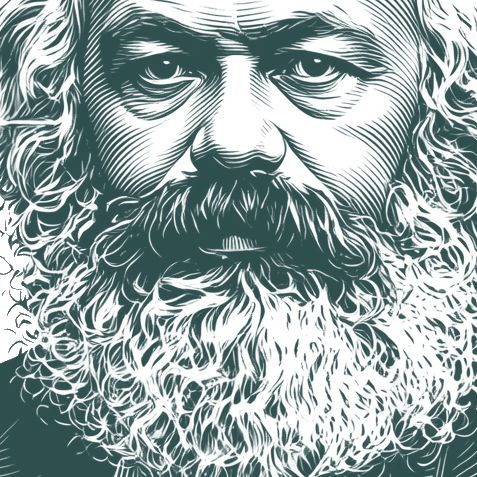
Karl Heinrich Marx (5 May 1818 – 14 March 1883) was a German political philosopher, economist, historian, sociologist, journalist and revolutionary socialist. Marx's work in economics laid the basis for labor theory of value, and has influenced much of subsequent economic thought. He published many works during his lifetime, including The Communist Manifesto (1848) and the first volume of Das Kapital (1867), the two later volumes being completed by his collaborator Friedrich Engels.
Biography information from
Wikiquote·
Portrait adapted from
Wikimedia Commons, John Jabez Edwin Mayall (Public domain / CC0)
Also Known As
Pen Names:
Glückskind
Alternative Names:
Karl Heinrich Marx
•
Karl H. Marx
•
Marx
Christ represents originally: 1) men before God; 2) God for men; 3) men to man.
Similarly, money represents originally, in accordance with the idea of money: 1) private property for private property; 2) society for private property; 3) private property for society.
But Christ is alienated God and alienated man. God has value only insofar as he represents Christ, and man has value only insofar as he represents Christ. It is the same with money.
In the social production of their life, men enter into definite relations that are indispensable and independent of their will; these relations of production correspond to a definite stage of development of their material forces of production. The sum total of these relations of production constitutes the economic structure of society — the real foundation, on which rises a legal and political superstructure and to which correspond definite forms of social consciousness. The mode of production of material life determines the social, political and intellectual life process in general. It is not the consciousness of men that determines their being, but, on the contrary, their social being that determines their consciousness. [Es ist nicht das Bewußtsein der Menschen, das ihr Sein, sondern umgekehrt ihr gesellschaftliches Sein, das ihr Bewusstsein bestimmt.] At a certain stage of their development, the material productive forces in society come in conflict with the existing relations of production, or — what is but a legal expression for the same thing — with the property relations within which they have been at work before. From forms of development of the productive forces these relations turn into fetters. Then begins an epoch of social revolution. With the change of the economic foundation the entire immense superstructure is more or less rapidly transformed. In considering such transformations a distinction should always be made between the material transformation of the economic conditions of production, which can be determined with the precision of natural science, and the legal, political, religious, aesthetic or philosophic — in short, ideological forms in which men become conscious of this conflict and fight it out. Just as our opinion of an individual is not based on what he thinks of himself, so we can not judge of such a period of transformation by its own consciousness; on the contrary, this consciousness must be explained rather from the contradictions of material life, from the existing conflict between the social productive forces and the relations of production. No social order ever disappears before all the productive forces for which there is room in it have been developed; and new, higher relations of production never appear before the material conditions of their existence have matured in the womb of the old society itself. Therefore, mankind always sets itself only such tasks as it can solve; since, looking at the matter more closely, we will always find that the task itself arises only when the material conditions necessary for its solution already exist or are at least in the process of formation. In broad outlines we can designate the Asiatic, the ancient, the feudal, and the modern bourgeois modes of production as so many progressive epochs in the economic formation of society. The bourgeois relations of production are the last antagonistic form of the social process of production — antagonistic not in the sense of individual antagonism, but of one arising from the social conditions of life of the individuals; at the same time the productive forces developing in the womb of bourgeois society create the material conditions for the solution of that antagonism. This social formation constitutes, therefore, the closing chapter of the prehistoric stage of human society.
Go Premium
Support Quotewise while enjoying an ad-free experience and premium features.
The progressive tendency of the general rate of profit to fall is, therefore, just an expression peculiar to the capitalist mode of production of the progressive development of the social productivity of labour. This does not mean to say that the rate of profit may not fall temporarily for other reasons. But proceeding from the nature of the capitalist mode of production, it is thereby proved a logical necessity that in its development the general average rate of surplus-value must express itself in a falling general rate of profit. Since the mass of the employed living labour is continually on the decline as compared to the mass of materialised labour set in motion by it, i.e., to the productively consumed means of production, it follows that the portion of living labour, unpaid and congealed in surplus-value, must also be continually on the decrease compared to the amount of value represented by the invested total capital. Since the ratio of the mass of surplus-value to the value of the invested total capital forms the rate of profit, this rate must constantly fall.