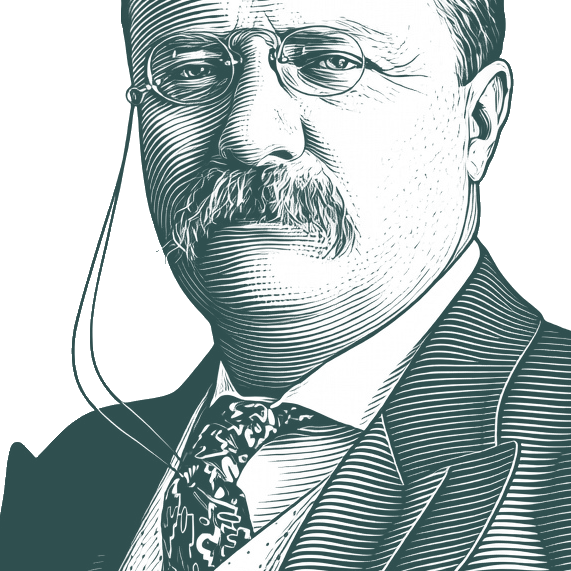
At many stages in the advance of humanity, this conflict between the men who possess more than they have earned and the men who have earned more than… - Theodore Roosevelt
""
At many stages in the advance of humanity, this conflict between the men who possess more than they have earned and the men who have earned more than they possess is the central condition of progress. In our day it appears as the struggle of freemen to gain and hold the right of self-government as against the special interests, who twist the methods of free government into machinery for defeating the popular will. At every stage, and under all circumstances, the essence of the struggle is to equalize opportunity, destroy privilege, and give to the life and citizenship of every individual the highest possible value both to himself and to the commonwealth.
Theodore Roosevelt, Jr. (27 October 1858 – 6 January 1919), also known as T.R. or Teddy, was an American statesman, author, explorer, soldier, naturalist, and reformer who served as the 26th president of the United States from 1901 to 1909. As a leader of the Republican Party during this time, he became a driving force for the Progressive Era in the United States in the early 20th century.
Biography information from
Wikiquote·
Portrait adapted from
Wikimedia Commons, Adam Cuerden (Public domain / CC0)
Also Known As
Birth Name:
Theodore Roosevelt Jr.
Also Known As:Teddy
Alternative Names:
Teddy Roosevelt
•
Theodore Roosevelt, Jr.
•
T. Roosevelt
•
T. Roosevelt, Jr.
•
T. R.
"I have always been fond of Josh Billings's remark that "it is much easier to be a harmless dove than a wise serpent." There are plenty of decent legislators, and plenty of able legislators; but the blamelessness and the fighting edge are not always combined. Both qualities are necessary for the man who is to wage active battle against the powers that prey."
I have no sympathy whatever with writing lists of the One Hundred Best Books, or the Five-Foot Library. It is all right for a man to amuse himself by composing a list of a hundred very good books; and if he is to go off for a year or so where he cannot get many books, it is an excellent thing to choose a five-foot library of particular books which in that particular year and on that particular trip he would like to read. But there is no such thing as a hundred books that are best for all men, or for the majority of men, or for one man at all times; and there is no such thing as a five-foot library which will satisfy the needs of even one particular man on different occasions extending over a number of years.
Try QuoteGPT
Chat naturally about what you need. Each answer links back to real quotes with citations.
The people as a whole can be benefited morally and materially by a system which shall permit of ample reward for exceptional efficiency, but which shall nevertheless secure to the average man, who does his work faithfully and well, the reward to which he is entitled. Remember that I speak only of the man who does his work faithfully and well. The man who shirks his work, who is lazy or vicious, or even merely incompetent, deserves scant consideration; we may be sorry for his family, but it is folly to waste sympathy on the man himself; and it is also folly for sentimentalists to try to shift the burden of blame from such a man himself to “society” and it is an outrage to give him the reward given to his hard-working, upright, and efficient brother. Still less should we waste sympathy on the criminal; there are altogether too many honest men who need it; and one chief point in dealing with the criminal should be to make him understand that he will be in personal peril if he becomes a lawbreaker. I realize entirely that in the last analysis, with the nation as with the individual, it is private character that counts for most. It is because of this realization that I gladly lay myself open to the charge that I preach too much, and dwell too much upon moral commonplaces; for though I believe with all my heart in the nationalization of this Nation—in the collective use on behalf of the American people of the governmental powers which can be derived only from the American people as a whole—yet I believe even more in the practical application by the individual of those great fundamental moralities.