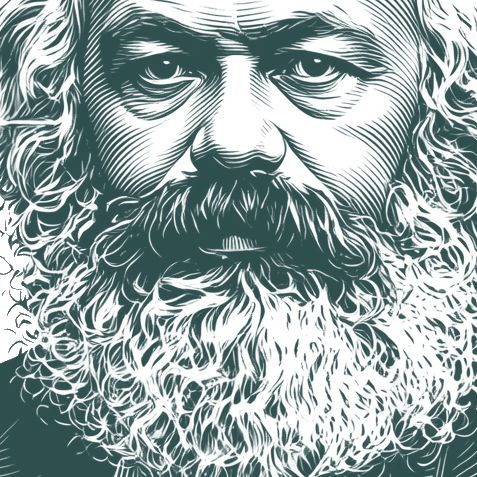
Karl Heinrich Marx (5 May 1818 – 14 March 1883) was a German political philosopher, economist, historian, sociologist, journalist and revolutionary socialist. Marx's work in economics laid the basis for labor theory of value, and has influenced much of subsequent economic thought. He published many works during his lifetime, including The Communist Manifesto (1848) and the first volume of Das Kapital (1867), the two later volumes being completed by his collaborator Friedrich Engels.
Biography information from
Wikiquote·
Portrait adapted from
Wikimedia Commons, John Jabez Edwin Mayall (Public domain / CC0)
Also Known As
Pen Names:
Glückskind
Alternative Names:
Karl Heinrich Marx
•
Karl H. Marx
•
Marx
Religion is the sigh of the oppressed creature, the heart of a heartless world and the soul of soulless conditions. It is the opium of the people.
Darwin has interested us in the history of Nature’s Technology, i.e., in the formation of the organs of plants and animals, which organs serve as instruments of production for sustaining life. Does not the history of the productive organs of man, of organs that are the material basis of all social organisation, deserve equal attention? And would not such a history be easier to compile, since, as Vico says, human history differs from natural history in this, that we have made the former, but not the latter? Technology discloses man’s mode of dealing with Nature, the process of production by which he sustains his life, and thereby also lays bare the mode of formation of his social relations, and of the mental conceptions that flow from them. Every history of religion, even, that fails to take account of this material basis, is uncritical. It is, in reality, much easier to discover by analysis the earthly core of the misty creations of religion, than, conversely, it is, to develop from the actual relations of life the corresponding celestialised forms of those relations. The latter method is the only materialistic, and therefore the only scientific one. The weak points in the abstract materialism of natural science, a materialism that excludes history and its process, are at once evident from the abstract and ideological conceptions of its spokesmen, whenever they venture beyond the bounds of their own speciality.
[Chapter Fifteen: Machinery and Modern Industry; Footnote 4]
Technology discloses the active relation of man towards nature, as well as the direct process of production of his very life, and thereby the process of production of his basic societal relations, of his own mentality, and his images of society, too.