IN A MUCH QUOTED PASSAGE in his inaugural address, President Kennedy said, “Ask not what your country can do for you — ask what you can do for your c… - Milton Friedman
""
IN A MUCH QUOTED PASSAGE in his inaugural address, President Kennedy said, “Ask not what your country can do for you — ask what you can do for your country.” It is a striking sign of the temper of our times that the controversy about this passage centered on its origin and not on its content. Neither half of the statement expresses a relation between the citizen and his government that is worthy of the ideals of free men in a free society. The paternalistic “what your country can do for you” implies that government is the patron, the citizen the ward, a view that is at odds with the free man’s belief in his own responsibility for his own destiny. The organismic, “what you can do for your country” implies that government is the master or the deity, the citizen, the servant or the votary. To the free man, the country is the collection of individuals who compose it, not something over and above them. He is proud of a common heritage and loyal to common traditions. But he regards government as a means, an instrumentality, neither a grantor of favors and gifts, nor a master or god to be blindly worshipped and served. He recognizes no national goal except as it is the consensus of the goals that the citizens severally serve. He recognizes no national purpose except as it is the consensus of the purposes for which the citizens severally strive. The free man will ask neither what his country can do for him nor what he can do for his country. He will ask rather “What can I and my compatriots do through government” to help us discharge our individual responsibilities, to achieve our several goals and purposes, and above all, to protect our freedom? And he will accompany this question with another: How can we keep the government we create from becoming a Frankenstein that will destroy the very freedom we establish it to protect? Freedom is
English
Collect this quote
About
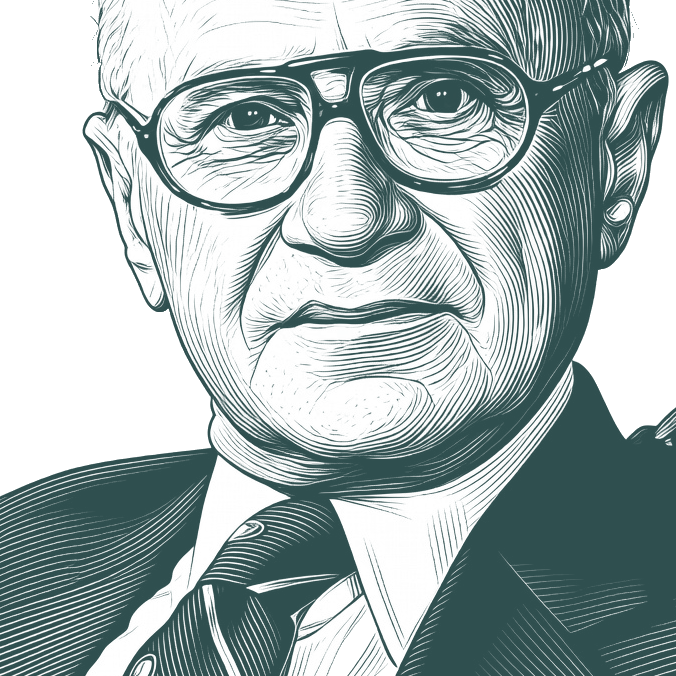
Milton Friedman
Milton Friedman (31 July 1912 – 16 November 2006) was an American economist noted for his support for free markets and a reduction in the size of government. In 1976 he was awarded a Nobel Prize in Economics.
Biography information from
Wikiquote·
Portrait adapted from
Wikimedia Commons, Bachrach Studios (Public domain / CC0)
Related quotes. More quotes will automatically load as you scroll down, or you can use the load more buttons.
Shorter versions of this quote
President Kennedy said, “Ask not what your country can do for you — ask what you can do for your country.”… Neither half of that statement expresses a relation between the citizen and his government that is worthy of the ideals of free men in a free society. “What your country can do for you” implies that the government is the patron, the citizen the ward. “What you can do for your country” assumes that the government is the master, the citizen the servant.
If a tax cut increases government revenues, you haven't cut taxes enough.
You can not simultaneously have free immigration and a welfare state.
The great achievements of western capitalism have rebounded primarily to the benefit of the ordinary person. These achievements have made available to the masses conveniences and amenities that were previously the exclusive prerogative of the rich and powerful.