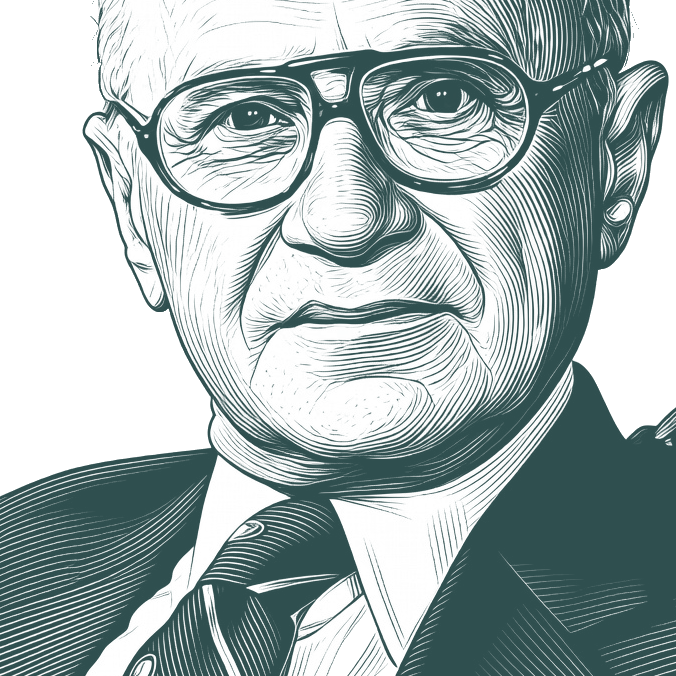
Is it really true that political self-interest is nobler somehow than economic self-interest? . . . And just tell me where in the world you find thes… - Milton Friedman
""
Is it really true that political self-interest is nobler somehow than economic self-interest? . . . And just tell me where in the world you find these angels who are going to organize society for us.
English
Collect this quote
About
Milton Friedman
Milton Friedman (31 July 1912 – 16 November 2006) was an American economist noted for his support for free markets and a reduction in the size of government. In 1976 he was awarded a Nobel Prize in Economics.
Biography information from
Wikiquote·
Portrait adapted from
Wikimedia Commons, Bachrach Studios (Public domain / CC0)
The way you solve things is by making it politically profitable for the wrong people to do the right thing.
The family, rather than the individual, has always been and remains today the basic building block of our society, though its hold has clearly been weakening — one of the most unfortunate consequences of the growth of government paternalism.
Try QuoteGPT
Chat naturally about what you need. Each answer links back to real quotes with citations.
From the founding of the Republic to 1929, spending by governments at all levels, federal, state, and local, never exceeded 12 percent of the national income except in time of major war, and two-thirds of that was state and local spending. Federal spending typically amounted to 3 percent or less of the national income. Since 1933 government spending has never been less than 20 percent of national income and is now over 40 percent, and two-thirds of that is spending by the federal government. True, much of the period since the end of World War II has been a period of cold or hot war. However, since 1946 nondefense spending alone has never been less than 16 percent of the national income and is now roughly one-third the national income. Federal government spending alone is more than one-quarter of the national income in total, and more than a fifth for nondefense purposes alone. By this measure the role of the federal government in the economy has multiplied roughly tenfold in the past half-century.