Now, this means that our government, National and State, must be freed from the sinister influence or control of special interests. Exactly as the sp… - Theodore Roosevelt
""
Now, this means that our government, National and State, must be freed from the sinister influence or control of special interests. Exactly as the special interests of cotton and slavery threatened our political integrity before the Civil War, so now the great special business interests too often control and corrupt the men and methods of government for their own profit. We must drive the special interests out of politics. That is one of our tasks to-day. Every special interest is entitled to justice-full, fair, and complete — and, now, mind you, if there were any attempt by mob-violence to plunder and work harm to the special interest, whatever it may be, that I most dislike, and the wealthy man, whomsoever he may be, for whom I have the greatest contempt, I would fight for him, and you would if you were worth your salt. He should have justice. For every special interest is entitled to justice, but not one is entitled to a vote in Congress, to a voice on the bench, or to representation in any public office. The Constitution guarantees protection to property, and we must make that promise good. But it does not give the right of suffrage to any corporation.
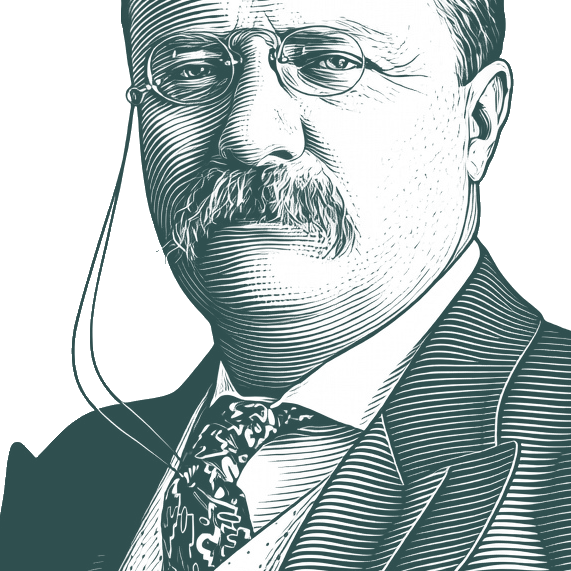
Theodore Roosevelt, Jr. (27 October 1858 – 6 January 1919), also known as T.R. or Teddy, was an American statesman, author, explorer, soldier, naturalist, and reformer who served as the 26th president of the United States from 1901 to 1909. As a leader of the Republican Party during this time, he became a driving force for the Progressive Era in the United States in the early 20th century.
Biography information from
Wikiquote·
Portrait adapted from
Wikimedia Commons, Adam Cuerden (Public domain / CC0)
Also Known As
Birth Name:
Theodore Roosevelt Jr.
Also Known As:Teddy
Alternative Names:
Teddy Roosevelt
•
Theodore Roosevelt, Jr.
•
T. Roosevelt
•
T. Roosevelt, Jr.
•
T. R.
Related quotes. More quotes will automatically load as you scroll down, or you can use the load more buttons.
Shorter versions of this quote
Our government, National and State, must be freed from the sinister influence or control of special interests. Exactly as the special interests of cotton and slavery threatened our political integrity before the Civil War, so now the great special business interests too often control and corrupt the men and methods of government for their own profit. We must drive the special interests out of politics.
Behind the ostensible government sits enthroned an invisible government owing no allegiance and acknowledging no responsibility to the people. To destroy this invisible government, to befoul the unholy alliance between corrupt business and corrupt politics is the first task of the statesmanship of today.
"90% of the work in this country is done by people who don't feel good".
Try QuoteGPT
Chat naturally about what you need. Each answer links back to real quotes with citations.
Above all, in this speech, as in so many others, he taught a lesson in wise kindliness and charity; an indispensable lesson to us of to-day, for if we approach the work of reform in a spirit of vindictiveness-in a spirit of reckless disregard for the rights of others, or of hatred for men because they are better off than ourselves—we are sure in the end to do not good but damage to all mankind, and especially to those whose especial champions we pro-fess ourselves to be.