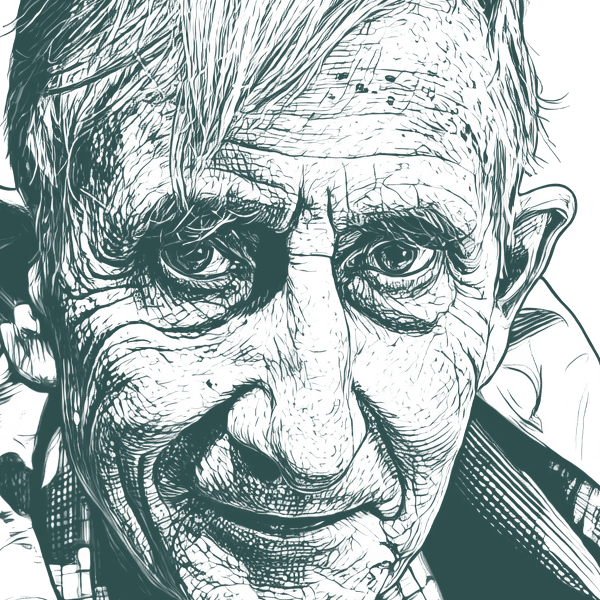
After sketching his program for the scientific revolution that he foresaw, Bacon ends his account with a prayer: "Humbly we pray that this mind may b… - Freeman Dyson
""
After sketching his program for the scientific revolution that he foresaw, Bacon ends his account with a prayer: "Humbly we pray that this mind may be steadfast in us, and that through these our hands, and the hands of others to whom thou shalt give the same spirit, thou wilt vouchsafe to endow the human family with new mercies". That is still a good prayer for all of us as we begin the twenty-first century.
Freeman John Dyson (15 December 1923 – 28 February 2020) was an English-born American physicist, mathematician, and futurist, famous for his work in quantum mechanics, nuclear weapons design and policy, and the search for extraterrestrial intelligence. He was the winner of the Templeton Prize in the year 2000.
Robida in 1883 published cartoon pictures of flat television screens, test-tube babies, bomber airplanes, and chemical warfare. Robida understood, as Verne and Wells did not, that the twentieth would be the century of world wars.
After all, Rutherford had as deep a sense of the mysteries of nature as Einstein. And the human spirit expresses itself as eloquently in the work of human hands as in the work of human minds. Rutherford was supreme as an experimenter and Einstein was supreme as a theorist, but each of them held the other in deep respect. Both of them understood that the human spirit is at its best when hands and minds are working together.
Works in ChatGPT, Claude, or Any AI
Add semantic quote search to your AI assistant via MCP. One command setup.
In contrast to Kuhn, Galison in his classic work Image and Logic, published in 1997, describes the history of particle physics as a history of tools rather than ideas. According to Image and Logic, the progress of science is tool-driven. The tools of particle physics are of two kinds, optical and electronic. The optical tools are devices such as cloud chambers, bubble chambers, and photographic emulsions, which display particle interactions visually by means of images. The images record the tracks of particles. An experienced experimenter can see at once from the image when a particle is doing something unexpected. Optical tools are more likely to lead to discoveries that are qualitatively new.
On the other hand, electronic tools are better for answering quantitative questions. Electronic detectors such as the Geiger counters that measure radioactivity in the cellars of old houses are based on logic. They are programmed to ask simple questions each time they detect a particle, and to record whether the answers to the questions are yes or no. They can detect particle collisions as at rates of millions per second, sort them into yes's and no's, and count the number that answered yes and the number that answered no. The history of particle physics may be divided into two periods, the earlier period ending about 1980 when optical detectors and images were dominant, and the later period when electronic detectors and logic were dominant. Before the transition, science advanced by making qualitative discoveries of new particles and new relationships between particles. After the transition, with the zoo of known particles more or less complete, the science advanced by measuring their interactions with greater and greater precision. In both periods, before and after the transition, tools were the driving force of progress.