Our basic problem is that we have three levels, I would say, of moral beliefs. We have the first instance, our intuitive moral feelings which are ada… - Friedrich Hayek
""
Our basic problem is that we have three levels, I would say, of moral beliefs. We have the first instance, our intuitive moral feelings which are adapted to the small, person-to-person society where we act for people whom we know and are served by people whom we know. Then, we have a society governed by moral traditions which, unlike what modern rationalists believe, are not intellectual discoveries of men who designed them, but as a result of a persons, which I now prefer to describe as term of 'group selection.' Those groups who had accidentally developed such as the tradition of private property and the family who did succeed, but never understood this. So we owe our present extended order of human cooperation very largely to a moral tradition which the intellectual does not approve of, because it has never been intellectually designed and it has to compete with a third level of moral beliefs, those which the morals which the intellectuals designed in the hope that they can better satisfy man's instincts than the traditional morals to do. And we live in a world where three moral traditions are in constant conflict, the innate ones, the traditional ones, and the intellectually designed ones, and ultimately, all our political conflicts of this time can be reduced as affected by a conflict between free moral tradition of a different nature, not only of different content.
English
Collect this quote
About
Friedrich Hayek
Friedrich August von Hayek CH (8 May 1899 – 23 March 1992) was an Austrian, later British, economist and philosopher best known for his defense of classical liberalism. In 1974, Hayek shared the (with Gunnar Myrdal) for his "pioneering work in the theory of money and economic fluctuations and … penetrating analysis of the interdependence of economic, social and institutional phenomena". (Nobel Memorial Prize, 1974)
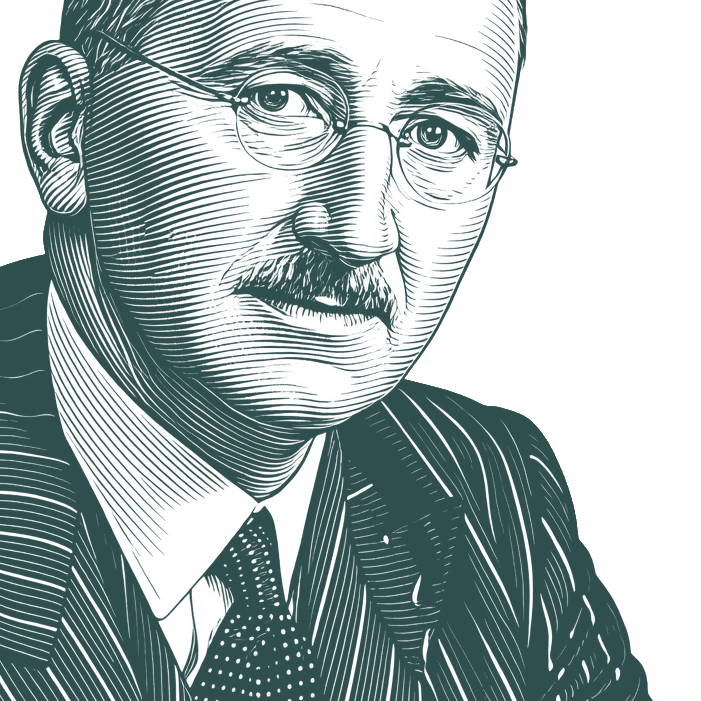
Portrait adapted from
Wikimedia Commons, The original uploader was DickClarkMises at English Wikipedia. (CC BY-SA)
Also Known As
Native Name:
Friedrich August von Hayek
Alternative Names:
Friedrich von Hayek
•
Friedrich A. von Hayek
•
Friedrich A. Von Hayek
•
F. A. von Hayek
•
Friedrich August Von Hayek
•
Hayek
•
F. A. Hayek
Yet, though the French Revolution was so largely inspired by the ideal of the Rule of Law, it is questionable whether it really helped the advance towards that ideal. In its course too many different aspirations gained influence which it was difficult to reconcile with that ideal.
Governments have assumed a much more active part in controlling money, and this has been as much a cause as a consequence of instability.
Opening of The Constitution of Liberty ch. 21; Hayek goes on to reject removing government control of money as politically impracticable and probably undesirable.
Conservatism, though a necessary element in any stable society, is not a social program; in its paternalistic, nationalistic and power adoring tendencies it is often closer to socialism than true liberalism; and with its traditionalistic, anti-intellectual, and often mystical propensities it will never, except in short periods of disillusionment, appeal to the young and all those others who believe that some changes are desirable if this world is to become a better place.