"Ritengo che la cosa più misericordiosa al mondo sia l'incapacità della mente umana di mettere in correlazione tutti i suoi contenuti. Viviamo su una… - H. P. Lovecraft
"Ritengo che la cosa più misericordiosa al mondo sia l'incapacità della mente umana di mettere in correlazione tutti i suoi contenuti. Viviamo su una placida isola di ignoranza nel mezzo del nero mare dell'infinito, e non era destino che navigassimo lontano. Le scienze, ciascuna tesa nella propria direzione, ci hanno finora nuociuto ben poco; ma, un giorno, la connessione di conoscenze disgiunte aprirà visioni talmente terrificanti della realtà, e della nostra spaventosa posizione in essa che, o diventeremo pazzi per la rivelazione, o fuggiremo dalla luce mortale nella pace e nella sicurezza di un nuovo Medioevo".
Italian
Collect this quote
About
H. P. Lovecraft
Howard Phillips Lovecraft (20 August 1890 – 15 March 1937) was an American author of fantasy, horror, and science fiction, known for combining these three genres within single narratives and best remembered for the creation of the Cthulhu Mythos. He is considered, along with Edgar Allan Poe, to be one of the greatest Horror writers.
Biography information from
Wikiquote·
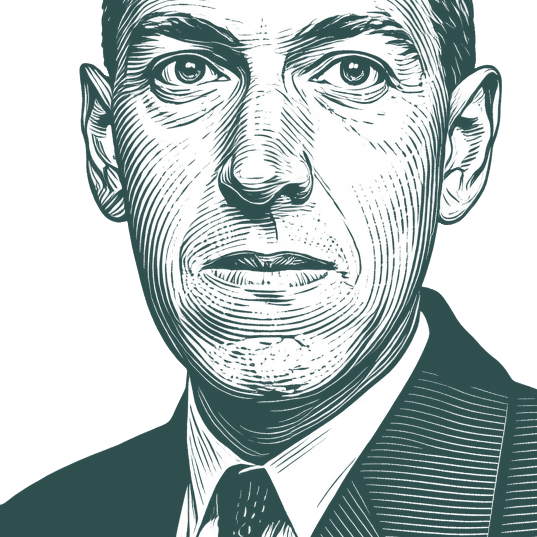
Portrait adapted from
Wikimedia Commons, Lucius B. Truesdell (Public domain / CC0)
Also Known As
Pen Names:
Ward Phillips
Native Name:
Howard Phillips Lovecraft
Alternative Names:
Howard P. Lovecraft
•
HPL
•
E'ch-Pi-El
•
Grandpa Theobald
•
Lovecraft
It seemed to be a sort of monster, or symbol representing a monster, of a form which only a diseased fancy could conceive. If I say that my somewhat extravagant imagination yielded simultaneous pictures of an octopus, a dragon, and a human caricature, I shall not be unfaithful to the spirit of the thing. A
I beheld such a sight as I had never beheld before, and which no living person can have seen save in the delirium of fever or the inferno of opium. The building stood on a narrow point of land — or what was now a narrow point of land — fully three hundred feet above what must lately have been a seething vortex of mad waters. On either side of the house there fell a newly washed-out precipice of red earth, whilst ahead of me the hideous waves were still rolling in frightfully, eating away the land with ghastly monotony and deliberation.
Works in ChatGPT, Claude, or Any AI
Add semantic quote search to your AI assistant via MCP. One command setup.
With five feeble senses we pretend to comprehend the boundlessly complex cosmos, yet other beings with wider, stronger, or different range of senses might not only see very differently the things we see, but might see and study whole worlds of matter, energy, and life which lie close at hand yet can never be detected with the senses we have.