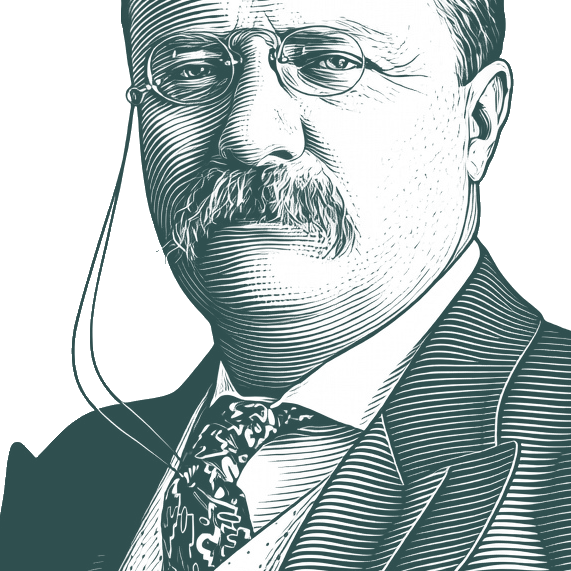
Theodore Roosevelt, Jr. (27 October 1858 – 6 January 1919), also known as T.R. or Teddy, was an American statesman, author, explorer, soldier, naturalist, and reformer who served as the 26th president of the United States from 1901 to 1909. As a leader of the Republican Party during this time, he became a driving force for the Progressive Era in the United States in the early 20th century.
Biography information from
Wikiquote·
Portrait adapted from
Wikimedia Commons, Adam Cuerden (Public domain / CC0)
Also Known As
Birth Name:
Theodore Roosevelt Jr.
Also Known As:Teddy
Alternative Names:
Teddy Roosevelt
•
Theodore Roosevelt, Jr.
•
T. Roosevelt
•
T. Roosevelt, Jr.
•
T. R.
It is not merely that we want to see the game played fairly. We also want to see the rules changed, so that there shall be both less opportunity and less temptation to cheat, and less chance for some few people to gain a profit to which either they are not entitled at all, or else which is so enormous as to be greatly in excess of what they deserve, even though their services have been great. We wish to do away with the profit that comes from the illegitimate exercise of cunning and craft. We also wish to secure a measurable equality of opportunity, a measurable equality of reward for services of similar value. To do all this, two, mutually supplementary movements are necessary. On the one hand, there must be - I think there now is - a genuine and permanent moral awakening, without which no wisdom of legislation or administration really means anything; and, on the other hand, we must try to secure the social and economic legislation without which any improvement due to purely moral agitation is necessarily evanescent.
There are two things that I want you to make up your minds to: first, that you are going to have a good time as long as you live – I have no use for the sour-faced man – and next, that you are going to do something worthwhile, that you are going to work hard and do the things you set out to do.
Go Premium
Support Quotewise while enjoying an ad-free experience and premium features.
As a result of our wrong thinking and supineness, we American citizens tend to breed a mass of men whose interests in governmental matters are often adverse to ours, who are thoroughly drilled, thoroughly organized, who make their livelihood out of politics, and who frequently make their livelihood out of bad politics.