It’s hard to believe you’d have an economy at all if you gave pink slips to more than half the labor force. But that — in slow motion — is what the i… - Kevin Kelly
""
It’s hard to believe you’d have an economy at all if you gave pink slips to more than half the labor force. But that — in slow motion — is what the industrial revolution did to the workforce of the early 19th century. Two hundred years ago, 70 percent of American workers lived on the farm. Today automation has eliminated all but 1 percent of their jobs, replacing them (and their work animals) with machines. But the displaced workers did not sit idle. Instead, automation created hundreds of millions of jobs in entirely new fields. Those who once farmed were now manning the legions of factories that churned out farm equipment, cars, and other industrial products. Since then, wave upon wave of new occupations have arrived — appliance repair person, offset printer, food chemist, photographer, web designer — each building on previous automation. Today, the vast majority of us are doing jobs that no farmer from the 1800s could have imagined.
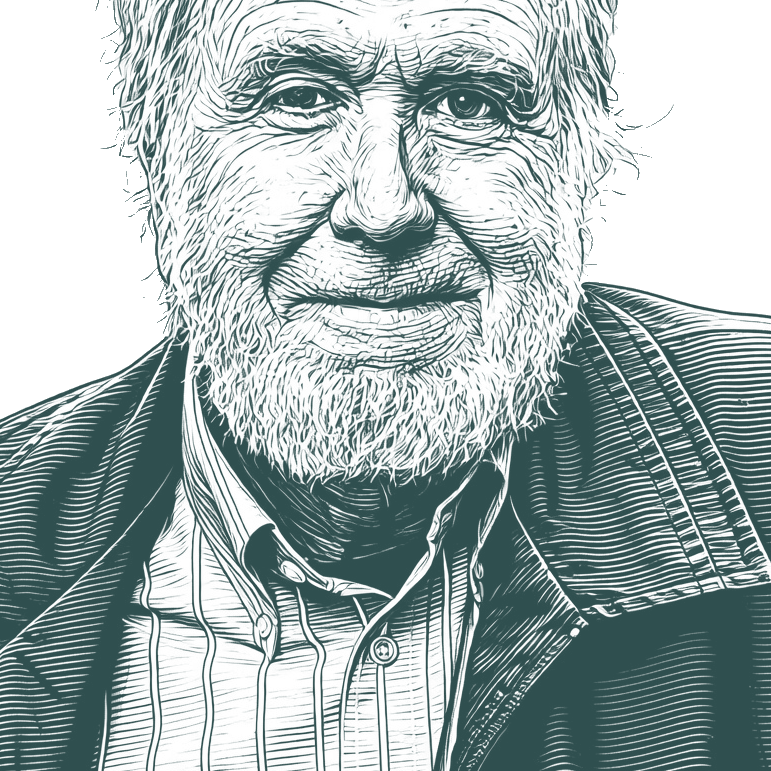
Kevin Kelly (born 1952) is the founding executive editor of Wired magazine, and a former editor/publisher of the Whole Earth Catalog. Kelly is considered an expert in digital culture, and is said to have helped make technology part of popular culture.
Biography information from
Wikiquote·
Portrait adapted from
Wikimedia Commons, Christopher Michel (CC BY)
When copies are free, you need to sell things that cannot be copied. Well, what can’t be copied? Trust, for instance. Trust cannot be reproduced in bulk. You can’t purchase trust wholesale. You can’t download trust and store it in a database or warehouse it. You can’t simply duplicate someone’s else’s trust. Trust must be earned, over time. It cannot be faked. Or counterfeited (at least for long). Since we prefer to deal with someone we can trust, we will often pay a premium for that privilege. We call that branding. Brand companies can command higher prices for similar products and services from companies without brands because they are trusted for what they promise. So trust is an intangible that has increasing value in a copy-saturated world.
A system is anything that talks to itself.
The central economic imperative of the new economy is to amplify relationships.