The poetical tendency of the present and of the preceding century has been divided in a manner singularly curious. One loud and conspicuous faction o… - H. P. Lovecraft
""
The poetical tendency of the present and of the preceding century has been divided in a manner singularly curious. One loud and conspicuous faction of bards, giving way to the corrupt influences of a decaying general culture, seems to have abandoned all the properties of versification and reason in its mad scramble after sensational novelty; whilst the other and quieter school constituting a more logical evolution from the poesy of the Georgian period, demands an accuracy of rhyme and metre unknown even to the polished artists of the age of Pope.
English
Collect this quote
About
H. P. Lovecraft
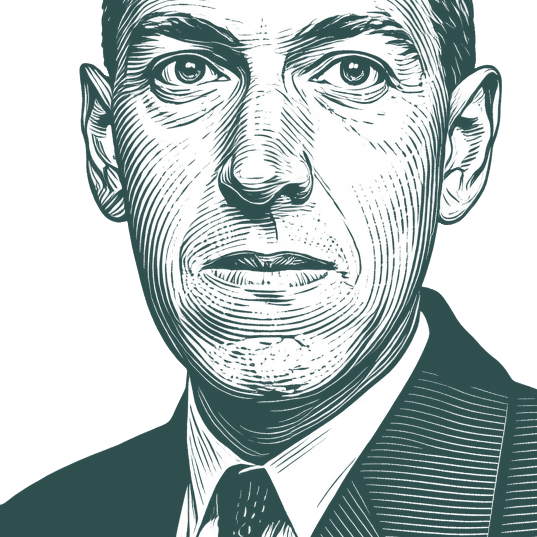
Howard Phillips Lovecraft (20 August 1890 – 15 March 1937) was an American author of fantasy, horror, and science fiction, known for combining these three genres within single narratives and best remembered for the creation of the Cthulhu Mythos. He is considered, along with Edgar Allan Poe, to be one of the greatest Horror writers.
Biography information from
Wikiquote·
Portrait adapted from
Wikimedia Commons, Lucius B. Truesdell (Public domain / CC0)
Also Known As
Pen Names:
Ward Phillips
Native Name:
Howard Phillips Lovecraft
Alternative Names:
Howard P. Lovecraft
•
HPL
•
E'ch-Pi-El
•
Grandpa Theobald
•
Lovecraft
I expect nothing of man, and disown the race. The only folly is expecting what is never attained; man is most contemptible when compared with his own pretensions. It is better to laugh at man from outside the universe, than to weep for him within.
The dog appeals to cheap and facile emotions; the cat to the deepest founts of imagination and cosmic perception in the human mind. It is no accident that the contemplative Egyptians, together with such later poetic spirits as Poe, Gautier, Baudelaire, and Swinburne, were all sincere worshippers of the supple grimalkin.
Try QuoteGPT
Chat naturally about what you need. Each answer links back to real quotes with citations.
That's because only a real artist knows the actual anatomy of the terrible or the physiology of fear - the exact sort of lines and proportions that connect up with latent instincts or hereditary memories of fright, and the proper colour contrasts and lighting effects to stir the dormant sense of strangeness.