president of the United States from 2009 to 2017 (born 1961)
Barack Hussein Obama II (born August 4, 1961) is an American politician who served as the 44th president of the United States of America from 2009 to 2017. Born in Hawaii, the son of a Kenyan father and a mother from Kansas, he won the 2008 presidential election and was re-elected president in November 2012. A member of the U.S. Democratic Party, he was the first African American president. Before becoming president, he represented the 13th district for three terms in the Illinois Senate from 1997 to 2004 and served as United States senator from Illinois between January 4, 2005 and November 16, 2008. While president, he was the recipient of the 2009 Nobel Peace Prize.
Bio from: Wikiquote (CC BY-SA 4.0) · Portrait adapted from: Wikimedia Commons, Official White House Photo by Pete Souza (Public domain / CC0)
From Wikidata (CC0)
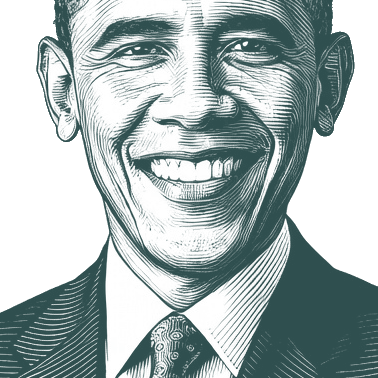

The American people don’t expect government to solve every problem. They don’t expect those of us in this chamber to agree on every issue. But they do expect us to put the nation’s interests before party. They do expect us to forge reasonable compromise where we can. For they know that America moves forward only when we do so together, and that the responsibility of improving this union remains the task of us all.
Advanced Search Filters
Filter search results by source, date, and more with our premium search tools.
The U.S. military has performed valiantly and brilliantly in Iraq. Our troops have done all that we have asked them to do and more. But no amount of American soldiers can solve the political differences at the heart of somebody else's civil war, nor settle the grievances in the hearts of the combatants. It is my firm belief that the responsible course of action - for the United States, for Iraq, and for our troops - is to oppose this reckless escalation and to pursue a new policy. This policy that I've laid out is consistent with what I have advocated for well over a year, with many of the recommendations of the bipartisan Iraq Study Group, and with what the American people demanded in the November election. When it comes to the war in Iraq, the time for promises and assurances, for waiting and patience, is over. Too many lives have been lost and too many billions have been spent for us to trust the President on another tried and failed policy opposed by generals and experts, Democrats and Republicans, Americans and many of the Iraqis themselves. It is time for us to fundamentally change our policy. It is time to give Iraqis their country back. And it is time to refocus America's efforts on the challenges we face at home and the wider struggle against terror yet to be won.
[T]o all who serve or have served, it has been the honor of my lifetime to be your Commander-in-Chief. And we all owe you a deep debt of gratitude. But protecting our way of life, that's not just the job of our military. . . . So, just as we, as citizens, must remain vigilant against external aggression, we must guard against a weakening of the values that make us who we are.
History reminds us that walls can be torn down. But the task is never easy. True partnership and true progress requires constant work and sustained sacrifice. They require sharing the burdens of development and diplomacy; of progress and peace. They require allies who will listen to each other, learn from each other and, most of all, trust each other.
I won’t be wading in early,” Teddy said. “Too many friends. But I can tell you this, Barack. The power to inspire is rare. Moments like this are rare. You think you may not be ready, that you’ll do it at a more convenient time. But you don’t choose the time. The time chooses you. Either you seize what may turn out to be the only chance you have, or you decide you’re willing to live with the knowledge that the chance has passed you by.
In many ways, fear is the force that stands between human beings and their dreams. Fear of conflict and the weapons of war. Fear of a future that is different from the past. Fear of changes that are reordering our societies and economy. Fear of people who look different, or come from a different place, or worship in a different way. In some of her darkest moments, when Aung San Suu Kyi was imprisoned, she wrote an essay about freedom from fear. She said fear of losing corrupts those who wield it -- “Fear of losing power corrupts those who wield it, and fear of the scourge of power corrupts those who are subject to it.” That's the fear that you can leave behind. We see that chance in leaders who are beginning to understand that power comes from appealing to people’s hopes, not people's fears.
Of course, neither the United States nor Europe are perfect in adherence to our ideals, nor do we claim to be the sole arbiter of what is right or wrong in the world. We are human, after all, and we face difficult choices about how to exercise our power. But part of what makes us different is that we welcome criticism, just as we welcome the responsibilities that come with global leadership.
Here's the advice I give everyone about marriage — is she someone you find interesting? … You will spend more time with this person than anyone else for the rest of your life, and there is nothing more important than always wanting to hear what she has to say about things … Does she make you laugh? And I don’t know if you want kids, but if you do, do you think she will be a good mom? Life is long. These are the things that really matter over the long term.
When politicians insult Muslims, when a mosque is vandalized, or a kid bullied, that doesn’t make us safer. That’s not telling it like it is. It’s just wrong. It diminishes us in the eyes of the world. It makes it harder to achieve our goals. And it betrays who we are as a country... What I’m asking for is hard. It’s easier to be cynical; to accept that change isn’t possible, and politics is hopeless, and to believe that our voices and actions don’t matter. But if we give up now, then we forsake a better future. Those with money and power will gain greater control over the decisions that could send a young soldier to war, or allow another economic disaster, or roll back the equal rights and voting rights that generations of Americans have fought, even died, to secure. As frustration grows, there will be voices urging us to fall back into tribes, to scapegoat fellow citizens who don’t look like us, or pray like us, or vote like we do, or share the same background. We can’t afford to go down that path. It won’t deliver the economy we want, or the security we want, but most of all, it contradicts everything that makes us the envy of the world.
Tonight, we gather to affirm the greatness of our nation—not because of the height of our skyscrapers, or the power of our military, or the size of our economy. Our pride is based on a very simple premise, summed up in a declaration made over two hundred years ago: "We hold these truths to be self-evident, that all men are created equal, that they are endowed by their Creator with certain inalienable rights, that among these are life, liberty and the pursuit of happiness." That is the true genius of America—a faith in simple dreams, an insistence on small miracles.
In the coming days, we’ll learn about the victims — young men and women who were studying and learning and working hard, their eyes set on the future, their dreams on what they could make of their lives. And America will wrap everyone who’s grieving with our prayers and our love.
But as I said just a few months ago, and I said a few months before that, and I said each time we see one of these mass shootings, our thoughts and prayers are not enough. It’s not enough. It does not capture the heartache and grief and anger that we should feel. And it does nothing to prevent this carnage from being inflicted someplace else in America — next week, or a couple of months from now.
We don’t yet know why this individual did what he did. And it’s fair to say that anybody who does this has a sickness in their minds, regardless of what they think their motivations may be. But we are not the only country on Earth that has people with mental illnesses or want to do harm to other people. We are the only advanced country on Earth that sees these kinds of mass shootings every few months.
Earlier this year, I answered a question in an interview by saying, “The United States of America is the one advanced nation on Earth in which we do not have sufficient common-sense gun-safety laws — even in the face of repeated mass killings.” And later that day, there was a mass shooting at a movie theater in Lafayette, Louisiana. That day! Somehow this has become routine. The reporting is routine. My response here at this podium ends up being routine. The conversation in the aftermath of it. We’ve become numb to this.
We talked about this after Columbine and Blacksburg, after Tucson, after Sandy Hook Elementary School shooting, after Aurora, after Charleston. It cannot be this easy for somebody who wants to inflict harm on other people to get his or her hands on a gun.
And what’s become routine, of course, is the response of those who oppose any kind of common-sense gun legislation.
As the world continues to change and we become more connected to each other, globalization will bring both benefits and disruptions to our lives. But either way, it's here, and it's not going away. We can try to build walls around us, and we can look inward, and we can respond by being frightened and angry about those disruptions.