president of the United States from 2009 to 2017 (born 1961)
Barack Hussein Obama II (born August 4, 1961) is an American politician who served as the 44th president of the United States of America from 2009 to 2017. Born in Hawaii, the son of a Kenyan father and a mother from Kansas, he won the 2008 presidential election and was re-elected president in November 2012. A member of the U.S. Democratic Party, he was the first African American president. Before becoming president, he represented the 13th district for three terms in the Illinois Senate from 1997 to 2004 and served as United States senator from Illinois between January 4, 2005 and November 16, 2008. While president, he was the recipient of the 2009 Nobel Peace Prize.
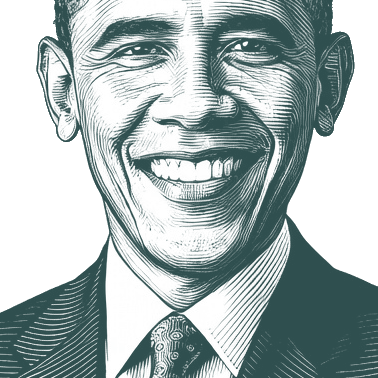
Bio from: Wikiquote (CC BY-SA 4.0) · Portrait adapted from: Wikimedia Commons, Official White House Photo by Pete Souza (Public domain / CC0)
From Wikidata (CC0)

Donald Trump calls our military a disaster. Apparently, he doesn’t know the men and women who make up the strongest fighting force the world has ever known. He suggests America is weak. He must not hear the billions of men and women and children, from the Baltics to Burma, who still look to America to be the light of freedom and dignity and human rights. He cozies up to Putin, praises Saddam Hussein, tells our NATO allies that stood by our side after 9/11 that they have to pay up if they want our protection. Well, America’s promises do not come with a price tag. We meet our commitments. We bear our burdens. That’s one of the reasons why almost every country on Earth sees America as stronger and more respected today than they did eight years ago when I took office.
But when there’s a vacuum in our democracy, when we don’t vote, when we take our basic rights and freedoms for granted, when we turn away and stop paying attention and stop engaging and stop believing and look for the newest diversion, the electronic versions of bread and circuses, then other voices fill the void. A politics of fear and resentment and retrenchment takes hold. And demagogues promise simple fixes to complex problems. They promise to fight for the little guy even as they cater to the wealthiest and the most powerful. They promise to clean up corruption and then plunder away. They start undermining norms that ensure accountability, try to change the rules to entrench their power further. And they appeal to racial nationalism that’s barely veiled, if veiled at all.
We know that states with the most gun laws tend to have the fewest gun deaths. So the notion that gun laws don’t work, or just will make it harder for law-abiding citizens and criminals will still get their guns is not borne out by the evidence.
We know that other countries, in response to one mass shooting, have been able to craft laws that almost eliminate mass shootings. Friends of ours, allies of ours — Great Britain, Australia, countries like ours. So we know there are ways to prevent it.
Whenever I travel the world, from Europe to Africa, South America to Southeast Asia, one of the things I most enjoy doing is meeting young men and women like you. It’s more fun than being in a conference room. And it’s also more important -- because you are the young leaders who will determine the future of this country and this region. So I’m going to keep my remarks short at the top, because I want to take as many questions and comments from you.
Centuries ago, when kings, emperors, and warlords reigned over much of the world, it was the English who first spelled out the rights and liberties of man in the Magna Carta. It was here, in this very hall, where the rule of law first developed, courts were established, disputes were settled, and citizens came to petition their leaders... Over time, the people of this nation waged a long and sometimes bloody struggle to expand and secure their freedom from the crown. Propelled by the ideals of the Enlightenment, they would ultimately forge an English Bill of Rights, and invest the power to govern in an elected parliament that’s gathered here today... What began on this island would inspire millions throughout the continent of Europe and across the world. But perhaps no one drew greater inspiration from these notions of freedom than your rabble-rousing colonists on the other side of the Atlantic. As Winston Churchill said, the "...Magna Carta, the Bill of Rights, Habeas Corpus, trial by jury, and English common law find their most famous expression in the American Declaration of Independence."
How does America find its way in this new, global economy? What will our place in history be? Like so much of the American story, once again, we face a choice. Once again, there are those who believe that there isn’t much we can do about this as a nation. That the best idea is to give everyone one big refund on their government—divvy it up by individual portions, in the form of tax breaks, hand it out, and encourage everyone to use their share to go buy their own health care, their own retirement plan, their own child care, their own education, and so on. In Washington, they call this the Ownership Society. But in our past there has been another term for it—Social Darwinism—every man or woman for him or herself. It’s a tempting idea, because it doesn’t require much thought or ingenuity. It allows us to say that those whose health care or tuition may rise faster than they can afford—tough luck. It allows us to say to the Maytag workers who have lost their job—life isn’t fair. It let’s us say to the child who was born into poverty—pull yourself up by your bootstraps. And it is especially tempting because each of us believes we will always be the winner in life’s lottery, that we’re the one who will be the next Donald Trump, or at least we won’t be the chump who Donald Trump says: “You’re fired!” But there is a problem. It won’t work. It ignores our history. It ignores the fact that it’s been government research and investment that made the railways possible and the internet possible. It’s been the creation of a massive middle class, through decent wages and benefits and public schools that allowed us all to prosper. Our economic dependence depended on individual initiative. It depended on a belief in the free market; but it has also depended on our sense of mutual regard for each other, the idea that everybody has a stake in the country, that we’re all in it together and everybody’s got a shot at opportunity. That’s what’s produced our unrivaled political stability.
We need to keep improving mental health care. I’ll never forget the soldiers I met at Fort Bliss. They were proud of their service, but they were struggling with issues like post-traumatic stress. So, for veterans with PTS, we made it easier for you to qualify for the VA care that you need -- no matter when you served. We’ve increased funding for veterans mental health care by more than 75 percent -- billions more dollars. More awareness and outreach -- because we have to end any shame or stigma that comes with going and getting help.
Politics is a battle of ideas. That's how our democracy was designed. In the course of a healthy debate, we prioritize different goals, and the different means of reaching them. But without some common baseline of facts, without a willingness to admit new information, and concede that your opponent might be making a fair point, and that science and reason matter - then we're going to keep talking past each other, and we'll make common ground and compromise impossible.
Throughout its history, Israel has been anxious to make peace with its Arab neighbors. If successful, the current peace process is a potential opportunity for Israel to increase its security, normalize relations with its neighbors, and create a more stable and prosperous Middle East. Resolution of the conflict depends on direct negotiations between the parties based on mutual respect and recognition. The United States’ commitment to Israel must continue so Israel can negotiate with its former and current adversaries from a position of strength... Israel can take risks for peace only because of unwavering American support.
Works in ChatGPT, Claude, or Any AI
Add semantic quote search to your AI assistant via MCP. One command setup.
America, I believe we can build on the progress we've made and continue to fight for new jobs and new opportunity and new security for the middle class. I believe we can keep the promise of our founders, the idea that if you're willing to work hard, it doesn't matter who you are or where you come from or what you look like or where you love. It doesn't matter whether you're black or white or Hispanic or Asian or Native American or young or old or rich or poor, able, disabled, gay or straight, you can make it here in America if you're willing to try. I believe we can seize this future together because we are not as divided as our politics suggests. We're not as cynical as the pundits believe. We are greater than the sum of our individual ambitions, and we remain more than a collection of red states and blue states. We are and forever will be the United States of America. And together with your help and God's grace we will continue our journey forward and remind the world just why it is that we live in the greatest nation on Earth.