president of the United States from 2009 to 2017 (born 1961)
Barack Hussein Obama II (born August 4, 1961) is an American politician who served as the 44th president of the United States of America from 2009 to 2017. Born in Hawaii, the son of a Kenyan father and a mother from Kansas, he won the 2008 presidential election and was re-elected president in November 2012. A member of the U.S. Democratic Party, he was the first African American president. Before becoming president, he represented the 13th district for three terms in the Illinois Senate from 1997 to 2004 and served as United States senator from Illinois between January 4, 2005 and November 16, 2008. While president, he was the recipient of the 2009 Nobel Peace Prize.
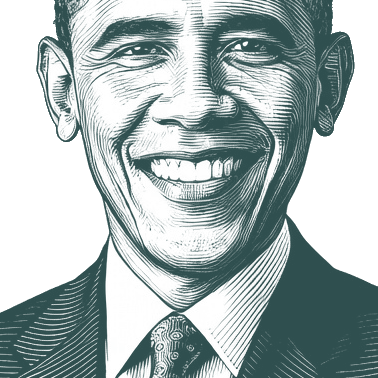
Bio from: Wikiquote (CC BY-SA 4.0) · Portrait adapted from: Wikimedia Commons, Official White House Photo by Pete Souza (Public domain / CC0)
From Wikidata (CC0)

Adam Smith’s central insight remains true today: There is no greater generator of wealth and innovation than a system of free enterprise that unleashes the full potential of individual men and women. That’s what led to the Industrial Revolution that began in the factories of Manchester. That is what led to the dawn of the Information Age that arose from the office parks of Silicon Valley. That’s why countries like China, India and Brazil are growing so rapidly -- because in fits and starts, they are moving toward market-based principles that the United States and the United Kingdom have always embraced.
People in every country should be free to choose and live their faith based upon the persuasion of the mind, and the heart, and the soul. This tolerance is essential for religion to thrive, but it is being challenged in many different ways. […] Freedom of religion is central to the ability of peoples to live together.
That we are in the midst of crisis is now well understood. Our nation is at war, against a far-reaching network of violence and hatred. Our economy is badly weakened, a consequence of greed and irresponsibility on the part of some, but also our collective failure to make hard choices and prepare the nation for a new age. Homes have been lost; jobs shed; businesses shuttered. Our health care is too costly; our schools fail too many; and each day brings further evidence that the ways we use energy strengthen our adversaries and threaten our planet.
As we meet here today, men and women and children are being tortured, detained and murdered by the Syrian regime. Thousands have been killed, many during the holy time of Ramadan. Thousands more have poured across Syria’s borders. The Syrian people have shown dignity and courage in their pursuit of justice -- protesting peacefully, standing silently in the streets, dying for the same values that this institution is supposed to stand for. And the question for us is clear: Will we stand with the Syrian people, or with their oppressors?
Short, owlish, with a smooth Kentucky accent, McConnell seemed an unlikely Republican leader. He showed no aptitude for schmoozing, backslapping, or rousing oratory. As far as anyone could tell, he had no close friends even in his own caucus, nor did he appear to have any strong convictions beyond an almost religious opposition to any version of campaign finance reform. Joe told me of one run-in he'd had on the Senate floor after the Republican leader blocked a bill Joe was sponsoring; when Joe tried to explain the bill's merits, McConnell raised his hand like a traffic cop and said, "You must be under the mistaken impression that I care." But what McConnell lacked in charisma or interest in policy he more than made up for in discipline, shrewdness, and shamelessness- all of which he employed in the single-minded and dispassionate pursuit of power.
I receive this honor with deep gratitude and great humility. It is an award that speaks to our highest aspirations — that for all the cruelty and hardship of our world, we are not mere prisoners of fate. Our actions matter, and can bend history in the direction of justice. And yet I would be remiss if I did not acknowledge the considerable controversy that your generous decision has generated. In part, this is because I am at the beginning, and not the end, of my labors on the world stage. Compared to some of the giants of history who've received this prize — Schweitzer and King; Marshall and Mandela — my accomplishments are slight. And then there are the men and women around the world who have been jailed and beaten in the pursuit of justice; those who toil in humanitarian organizations to relieve suffering; the unrecognized millions whose quiet acts of courage and compassion inspire even the most hardened cynics. I cannot argue with those who find these men and women — some known, some obscure to all but those they help — to be far more deserving of this honor than I. But perhaps the most profound issue surrounding my receipt of this prize is the fact that I am the Commander-in-Chief of the military of a nation in the midst of two wars. One of these wars is winding down. The other is a conflict that America did not seek; one in which we are joined by 42 other countries — including Norway — in an effort to defend ourselves and all nations from further attacks. Still, we are at war, and I'm responsible for the deployment of thousands of young Americans to battle in a distant land. Some will kill, and some will be killed. And so I come here with an acute sense of the costs of armed conflict — filled with difficult questions about the relationship between war and peace, and our effort to replace one with the other.
But we are here today because we know we cannot be complacent. For history travels not only forwards; history can travel backwards, history can travel sideways. And securing the gains this country has made requires the vigilance of its citizens. Our rights, our freedoms -- they are not given. They must be won. They must be nurtured through struggle and discipline, and persistence and faith. And one concern I have sometimes during these moments, the celebration of the signing of the Civil Rights Act, the March on Washington -- from a distance, sometimes these commemorations seem inevitable, they seem easy. All the pain and difficulty and struggle and doubt -- all that is rubbed away. And we look at ourselves and we say, oh, things are just too different now; we couldn’t possibly do what was done then -- these giants, what they accomplished. And yet, they were men and women, too. It wasn’t easy then. It wasn’t certain then. Still, the story of America is a story of progress. However slow, however incomplete, however harshly challenged at each point on our journey, however flawed our leaders, however many times we have to take a quarter of a loaf or half a loaf -- the story of America is a story of progress. And that’s true because of men like President Lyndon Baines Johnson.
In countries held together by borders drawn by colonial powers, with ethnic enclaves and tribal divisions, politics and elections can sometimes appear to be a zero-sum game. And so, given the difficulty in forging true democracy in the face of these pressures, it’s no surprise that some argue the future favors the strongman, a top-down model, rather than strong, democratic institutions. [...] I believe the road of true democracy remains the better path. I believe that in the 21st century, economies can only grow to a certain point until they need to open up -- because entrepreneurs need to access information in order to invent; young people need a global education in order to thrive; independent media needs to check the abuses of power. Without this evolution, ultimately expectations of people will not be met; suppression and stagnation will set in. And history shows that strongmen are then left with two paths -- permanent crackdown, which sparks strife at home, or scapegoating enemies abroad, which can lead to war.