Portuguese poet, writer, and philosopher (1888–1935); creator of the heteronymic system including Alberto Caeiro, Ricardo Reis, Álvaro de Campos, and Bernardo Soares
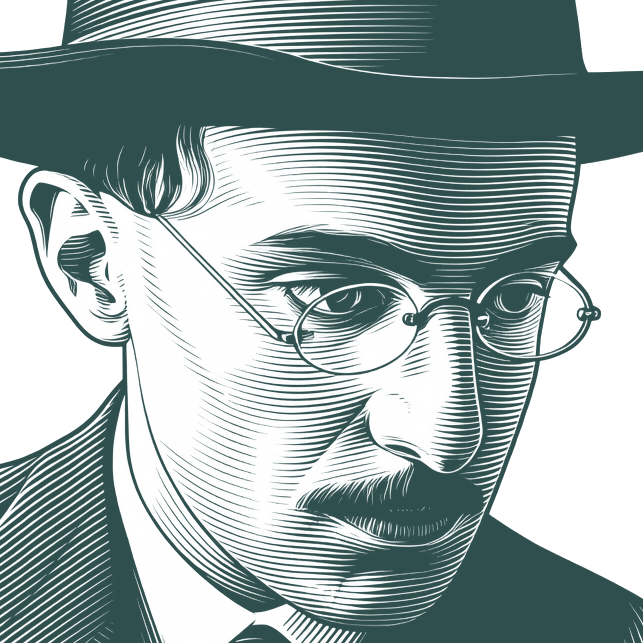
Fernando Pessoa (13 June 1888 – 30 November 1935) was a Portuguese poet and writer, most of whose work was published posthumously. He wrote frequently under heteronyms, alter egos with developed personalities, biographies, jobs, habits, attitudes, addresses, etc., who sometimes quoted and interacted with each other and other people.
Bio from: Wikiquote (CC BY-SA 4.0) · Portrait adapted from: Wikimedia Commons, S.A. e Maria José de Lencastre (Public domain / CC0)
From Wikidata (CC0)

I don't know if I have a fever, as I feel I do, or if I've stopped having the fever of sleeping through life. Yes, I repeat, I'm like a traveller who suddenly finds himself in a strange town, without knowing how he got there, which makes me think of those who lose their memory and for a long time are not themselves but someone else. I was someone else for a long time – since birth and consciousness – and suddenly I've woken up in the middle of a bridge, leaning over the river and knowing that I exist more solidly than the person I was up till now. But the city is unknown to me, the streets are new, and the trouble has no cure. And so, leaning over the bridge, I wait for the truth to go away and let me return to being fictitious and non-existent, intelligent and natural.
Works in ChatGPT, Claude, or Any AI
Add semantic quote search to your AI assistant via MCP. One command setup.
Original: Cada um tem a sua vaidade, e a vaidade de cada um é o seu esquecimento de que há outros com alma igual.
Original: Creio que dizer uma coisa é conservar-lhe a virtude e tirar-lhe o terror.
I'd like to run away, to flee from what I know, from what is mine, from what I love. I want to set off, not for some impossible Indies or for the great islands that lie far to the south of all other lands, but for anywhere, be it village or desert, that has the virtue of not being here. What I want is not to see these faces, this daily round of days. I want a rest from, to be other than, my habitual pretending. I want to feel the approach of sleep as if it were a promise of life, not rest. A hut by the sea, even a cave on a rugged mountain ledge, would be enough. Unfortunately, my will alone cannot give me that.
Slavery is the only law of life, there is no other, because this law must be obeyed; there is no possible rebellion against it or refuge from it. Some are born slaves, some become slaves, some have slavery thrust upon them. The cowardly love we all have of freedom -which if it were given to us we would all repudiate as being too new and strange –is the irrefutable proof of how our slavery weighs upon us.
To travel? In order to travel it's enough to be. [...] Why travel? In Madrid, in Berlin, in Persia, in China, at the Poles both, where would I be but in myself, and in the sort and kind of my sensations? Life is what we make of it. Travels are travellers. What we see is not what we see but what we are.
The Complete Work is essentially dramatic, thought it takes different forms - prose passages in this first volume, poems and philosophies in other volumes. It's the product of the temperament I've been blessed or cursed with - I'm not sure which. All I know is that the author of these lines (I'm not sure if also of these books) has never had just one personality, and has never thought or felt except dramatically - that is, through invented persons, or personalities, who are more capable than he of feeling what's to be felt.
Try QuoteGPT
Chat naturally about what you need. Each answer links back to real quotes with citations.
Let's adopt all the poses and gestures of something we aren't and don't wish to be, and don't even wish to be taken for being.
Let's buy books so as not to read them; let's go to concerts without caring to hear the music or see who's there; let's take long walks because we're sick of walking; and let's spend whole days in the country, just because it bores us. [23](Zenith trans.)