So, creatively, I was doubly blessed: constant relocation and parental disharmony. Add to these two gifts the well-established fact that many of the world’s greatest geniuses, both artistic and scientific, have been the product of serious maternal deprivation, and I am forced to the conclusion that if only my mother had been just a little more emotionally inadequate, I could have been HUGE.
English comedian and actor (born 1939)
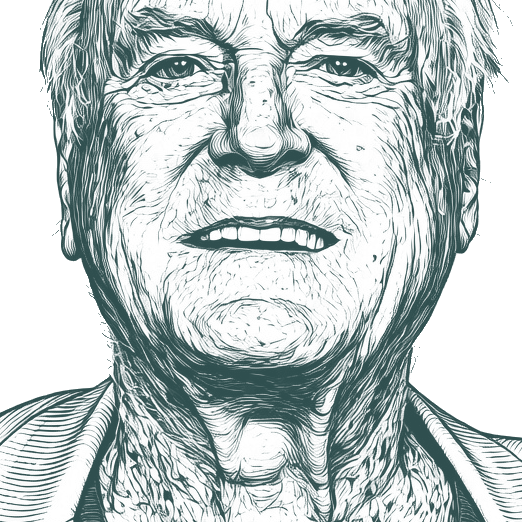
John Marwood Cleese (born 27 October 1939) is an English comedian and actor best known for being one of the members of the comedy group Monty Python and for co-writing the TV series Fawlty Towers in which he played Basil Fawlty.
Bio from: Wikiquote (CC BY-SA 4.0) · Portrait adapted from: Wikimedia Commons, Super Festivals from Ft. Lauderdale, USA (CC BY)
Alternative Names:
John Marwood Cleese
From Wikidata (CC0)

Self-confidence seemed to me more mimicry than anything else and I suggested visiting Clifton Zoo to watch the leaders in a group of baboons, and learn from them: make your gestures slow and deliberate; cultivate a deeper voice; appear casual at all times; eschew all rapid movements. That was all you had to do to look confident.
I found Toronto an immensely likeable city, spacious and gentle and slightly dignified, but in a low-key, friendly way. The only people who didn’t seem to think much of it were its inhabitants, who could hardly wait for you to ask directions, because that gave them the perfect opportunity to apologise for it. What they were apologising for I never understood. I think they felt uninteresting, compared with America. I took the opposite view; I remember reading about the doctrine of American “Exceptionalism” and thinking that what I liked so much about Canadians was that they consider themselves unexceptional. This modest, unthreatening attitude seems to produce a nation that is stable, safe, decent and well respected. It’s just a shame that for seven months of the year it’s so cold that only Canadians would put up with it.
The neurologist and psychologist Maurice Nicoll told how he had once asked his headmaster about a passage in the Bible, and after he had listened to the answer for some time, he realized that the man had no idea what he was talking about. What I admire about Nicoll is that he made this discovery when he was only ten. It took me another forty-five years before the penny dropped: very, very few people have any idea what they are talking about.
This parrot is no more! It has ceased to be! It's expired and gone to meet its maker! This is a late parrot! It's a stiff! Bereft of life, it rests in peace! If you hadn't nailed it to the perch, it would be pushing up the daisies! It's rung down the curtain and joined the choir invisible. This is an ex-parrot!
Works in ChatGPT, Claude, or Any AI
Add semantic quote search to your AI assistant via MCP. One command setup.
We adored it, and discussed it, and swapped jokes from it, and it made us feel more alive. In some way, it was cathartic: it exhilarated us by lifting us up above our everyday frustrations and boredoms. It gave us a liberating perspective on this odd event unfolding around us, called 'our life.' And when, years later, I became bewildered by the reception of Monty Python by some of our looniest fans, I suddenly realised they were experiencing exactly the combination of emotions that had rendered me such a devotee of the Goons, and so I was able to forgive them.
I had tracked down a little cafe in the next village, with a television set that was going to show the World Cup Final on the Saturday. I arrived there mid-morning when it was still deserted, had a couple of beers, ordered a sensational conejo au Franco, and then sat, drinking coffee, and watching the room fill up. With Germans. I was expecting plenty of locals and a sprinkling of tourists, even in an obscure little outpost like this, but not half the population of Dortmund. In fact, I came to the slow realisation as they poured in and sat around me . . . that I was the only Englishman there. They were very friendly, but there were many of them, and all my exits were cut off. What strategy could I employ? It was too late to pretend that I was German. I’d greeted the early arrivals with ‘Guten Tag! Ich liebe Deutschland’, but within a few seconds found myself conversing in English, in which they were all fluent. Perhaps, I hoped, they would think that I was an English-speaker but not actually English. A Rhodesian, possibly, or a Canadian, there just out of curiosity, to try to pick up the rules of this so-called ‘Beautiful Game’. But I knew that I lacked the self-control to fake an attitude of benevolent detachment while watching what was arguably the most important event since the Crucifixion, so I plumped for the role of the ultra-sporting, frightfully decent Upper-Class Twit, and consequently found myself shouting ‘Oh, well played, Germany!’ when Helmut Haller opened the scoring in the twelfth minute, and managing to restrain myself, when Geoff Hurst equalised, to ‘Good show! Bit lucky though!’ My fixed grin and easy manner did not betray the writhing contortions of my hands and legs beneath the table, however, and when Martin Peters put us ahead twelve minutes from the end, I clapped a little too violently; I tried to compensate with ‘Come on Germany! Give us a game!’ but that seemed to strike the wrong note. The most testing moment, though, came in the last minu