English comedian and actor (born 1939)
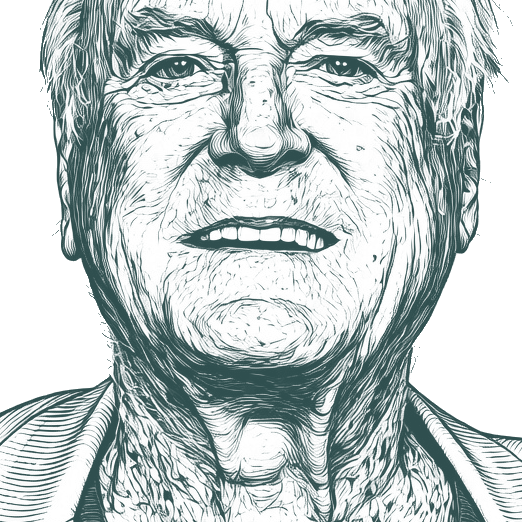
John Marwood Cleese (born 27 October 1939) is an English comedian and actor best known for being one of the members of the comedy group Monty Python and for co-writing the TV series Fawlty Towers in which he played Basil Fawlty.
Bio from: Wikiquote (CC BY-SA 4.0) · Portrait adapted from: Wikimedia Commons, Super Festivals from Ft. Lauderdale, USA (CC BY)
From Wikidata (CC0)
"SPIEGEL: You have a lot of respect for the Dalai Lama, you even rewrote some Buddhist writings for him. Are you a religious person?
Cleese: I certainly don't think much of organized religion. I am not committed to anything except the vague feeling that there is something more going on than the materialist reductionist people think. I think you can reduce suffering a little bit, like the Buddhists say, that is one of the few things I take seriously. But the idea that you can run this planet in a rational and kind way — I think it's not possible. There will always be these sociopaths at the top — selfish people, power-seekers who want to spend their whole lives seeking it. Robin Skynner, the psychiatrist that I wrote two books with, said to me that you could begin to enjoy life when you realized how bad the planet is, how hopeless everything is. I reached that point these last two or three years when I saw that our existence here is absolutely hopeless. I see the rich people have got a stranglehold on us. If somebody had said that to me when I was 20, I would have regarded him as a left-wing loony.
SPIEGEL: You may not have been a left-wing loony, but you were happy to attack and ridicule the church. The "Life of Brian," the story of a young man in Judea who isn't Jesus Christ, but is nevertheless followed like a savior and crucified afterwards, was regarded as blasphemy when it was released in 1979.
Cleese: Well there was a small number of people in country towns, all very conservative, who got upset and said, "You can't show the film." So people hired a coach and drove 15 miles to the next town and went to see the film there. But a lot of Christians said, "We got it, we know that the joke is not about religion, but about the way people follow religion." If Jesus saw the Spanish Inquisition I think he would have said, "What are you doing there?"
SPIEGEL: These days Muslims and Islam are risky subjects. Do you think they are good issues for satire?
Cleese: For s
It is terrifying how much of this deeply unkind, utterly pointless, in fact, mind-bogglingly COUNTERPRODUCTIVE kind of behaviour was meted out to children over the centuries by half-witted, power-crazed zombies like this heinous old bat — a large proportion of such psychopaths allegedly acting in the name of an all-loving God.
So I explained to Connie that she needed to send a green light by, for example, talking about her father in a relaxed manner for a few seconds; then, I said, the queries about him would start flooding in. But what struck me as so odd was that I had been acting on this understanding all my life without ever having brought it to consciousness. As the French (and the Paraguayans) say, “A fish does not know the water that it swims in.” And eighteen years later, when I was writing A Fish Called Wanda, I used this realisation, when Archie is trying to explain to Wanda the social straitjacket from which he is desperate to escape: Wanda, do you have any idea what it’s like being English? Being so correct all the time, being so stifled by this dread of, of doing the wrong thing, of saying to someone, “Are you married?” and hearing, “My wife left me this morning,” or saying, “Do you have children?” and being told they all burned to death on Wednesday. You see, Wanda, we’re all terrified of embarrassment. That’s why we’re so … dead. Most of my friends are dead, you know; we have these piles of corpses to dinner.
maps. I was less clueless about the basics of English, though I didn’t realise at the time that I was assuming that English grammar was the same as the Latin grammar I had been taught so well. (I remember that the first week I was there, a boy asked me during prep whether ager was second or third declension and I was able to tell him without pausing for thought that ager — a field — was second declension, so it went like annus, but that it dropped the “e,” as opposed to agger — a rampart — which was third declension, and retained the “e.” “My God,” I thought as he walked away, “Captain Lancaster did a good job.” My next thought was, “Lucky the boy didn’t ask me what a rampart was.…”) But given that I was teaching ten-year-olds, Geoffrey Tolson’s advice to “stay a page ahead” seemed perfectly sound. So I had no reason to believe, as I strode purposefully into the classroom to teach Form III their first history
Peter Sellers offered me a small part opposite him in a rather good scene where Sir Guy Grand purchases a ‘School of Rembrandt’ portrait and then cuts out the nose of it with a knife, explaining to my character (a snotty young art dealer) that he only collects noses. I, of course, have to react with horror, and I exclaim ‘Shit!’ This was quite a naughty word in 1968 – so naughty, in fact, that when, some months later, my scene was shown on television to promote the movie I became, as far as I know, the first person ever to say ‘shit’ on British television. (This, incidentally, is one of my three claims to fame: the others are that I have a species of lemur named after me, and that I was once French-kissed – on camera – by Tim Curry.)
I once compiled a list of events that frightened her, and it was quite comprehensive: very loud snoring; low-flying aircraft; church bells; fire engines; trains; buses and lorries; thunder; shouting; large cars; most medium-sized cars; noisy small cars; burglar alarms; fireworks, especially crackers; loud radios; barking dogs; whinnying horses; nearby silent horses; cows in general; megaphones; sheep; corks coming out of sparkling wine bottles; motorcycles, even very small ones; balloons being popped; vacuum cleaners (not being used by her); things being dropped; dinner gongs; parrot houses; whoopee cushions; chiming doorbells; hammering; bombs; hooters; old-fashioned alarm clocks; pneumatic drills; and hairdryers (even those used by her).
I now see, was the fact that there were so many areas of my emotional life where I was muddled and unresolved and therefore ripe for horrendous embarrassment that I was pointlessly guarded about everything. The lurking fear that I might accidentally give away something I did not want to reveal resulted in blanket self-censorship.
Works in ChatGPT, Claude, or Any AI
Add semantic quote search to your AI assistant via MCP. One command setup.
The problem was that I carried around with me a tendency to feel that other people’s respect for me would vanish if what I did was second rate. And while I accept that this “perfectionism” is likely to stimulate the production of better work, it doesn’t, unfortunately, go hand in hand with a relaxed and happy attitude to life.
<p>But once it's been agreed when that real-world decision has to happen, why make it before the deadline arrives?</p>
<p>Why</p>
<p>Well, it would be foolish, because if you can wait longer, two incredibly important things may happen.:</p>
<p>
You may get new information.
</p>
<p>
You may get new ideas.
</p>
<p>So why would you make a decision when you don't need to?</p>
the reunion show at London’s O2 arena. To ignore that might be perceived as skimping. So . . . What a huge success it was – although I say so, who shouldn’t. I refuse to be modest. Ten audiences of 16,000 loved it and gave us ten great warm, happy standing ovations, and I’ve only heard three snotty comments altogether (apart from the Daily Mail, who panned the show, claiming we had ‘mixed reviews’ – they were about as mixed as Hitler’s reviews at Nuremberg, a reference which the Mail, as a formerly pro-Nazi paper, should easily get).
The sour old cow gave me a sum much more difficult than any I had encountered before: say, a four-digit number divided by a three-digit number. I guessed how to do it, and got it wrong. Without offering help, she told me to do it again. I failed a second time; she warned me to try hard; I did; I failed again; and she told me to hold my hand out and, grasping it firmly, she caned the palm three times, hard. My first reaction was astonishment: none of my kindergartens had been Catholic establishments, so I was unprepared for this kind of assault. Then it hurt, a lot! My precious palm! When I first started having therapy twenty-five years later, this was one of the first traumas I recalled, and I was astonished at the power of the feelings that came flooding back: anger — no, fury; self-pity; humiliation; a deep, deep sense of hurt; and a pure indignation at not so much the unfairness, but the insanity of punishing someone physically for getting an answer wrong. It is terrifying how much of this deeply unkind, utterly pointless, in fact, mind-bogglingly COUNTERPRODUCTIVE kind of behaviour was meted out to children over the centuries by half-witted, power-crazed zombies like this heinous old bat — a large proportion of such psychopaths allegedly acting in the name of an all-loving God.