American Black rights activist (1925–1965)
El-Hajj Malik El-Shabazz, or Malcolm X, born Malcolm Little (19 May 1925 – 21 February 1965) was an American Muslim minister and a human rights activist. For many years, he was a major proponent of the Nation of Islam, espousing black supremacy, the separation of black and white Americans, and scoffing at the civil rights movement's emphasis on racial integration. By March 1964, he had grown disillusioned with the Nation of Islam and ultimately repudiated its teachings, embracing Sunni Islam; while continuing to emphasize Pan-Africanism, black self-determination, and black self-defense, disavowing racism. In February 1965, he was assassinated by three men, all of whom were affiliated with the Nation of Islam. The Autobiography of Malcolm X, published shortly after his death, is considered one of the most influential non-fiction books of the 20th century.
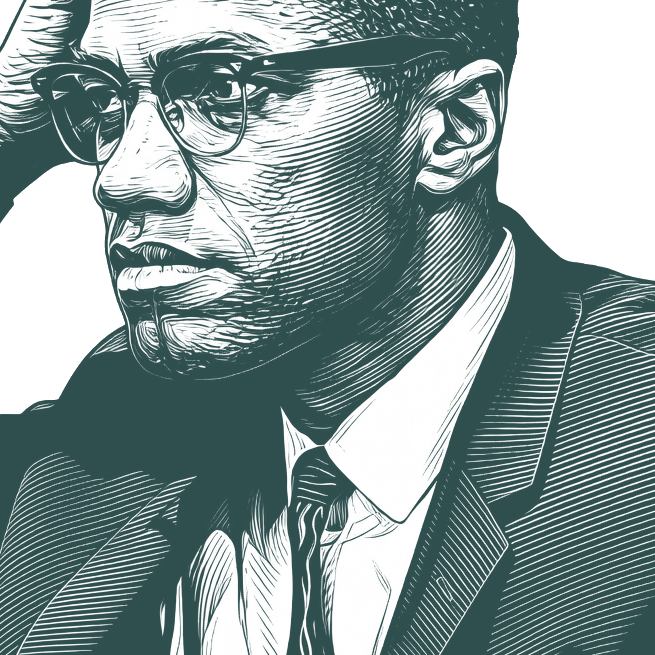
Bio from: Wikiquote (CC BY-SA 4.0) · Portrait adapted from: Wikimedia Commons, Marion S. Trikosko (Public domain / CC0)
From Wikidata (CC0)

I learned early that crying out in protest could accomplish things. My older brothers and sister had started to school when, sometimes, they would come in and ask for a buttered biscuit or something and my mother, impatiently, would tell them no. But I would cry out and make a fuss until I got what I wanted. I remember well how my mother asked me why I couldn't be a nice boy like Wilfred; but I would think to myself that Wilfred, for being so nice and quiet, often stayed hungry. So early in life, I had learned that if you want something, you had better make some noise.
You get your freedom by not being confined. You get freedom by letting your enemy know that you'll do anything to get your freedom. You'll get it. It's the only way you'll get it...So dont you run around here trying to make friends with somebody who's depriving you of your rights. They're not your friends. No, they're your enemies. Treat them like that and fight them, and you'll get your freedom. And after you get your freedom, your enemey will respect you. He will respect you. I say that with no hate. I have no hate in me. I don't have any hate, but I've got some sense...I'm not going to let somebody who hates me to tell me to love him. I'm not that way out.
Once you change your philosophy, you change your thought pattern. Once you change your thought pattern, you change your — your attitude. Once you change your attitude, it changes your behavior pattern and then you go on into some action. As long as you gotta sit-down philosophy, you’ll have a sit-down thought pattern, and as long as you think that old sit-down thought you’ll be in some kind of sit-down action.
"When I am dead — I say it that way because from the things I know, I do not expect to live long enough to read this book in its finished form — I want you to just watch and see if I'm not right in what I say: that the white man, in his press, is going to identify me with "hate". He will make use of me dead, as he has made use of me alive, as a convenient symbol, of "hatred" — and that will help him escape facing the truth that all I have been doing is holding up a mirror to reflect, to show, the history of unspeakable crimes that his race has committed against my race."
Enhance Your Quote Experience
Enjoy ad-free browsing, unlimited collections, and advanced search features with Premium.