The great fact underlying the claim for universal suffrage is that every man is himself and belongs to himself, and represents his own individuality, not only in form and features, but in thought and feeling. And the same is true of woman. She is herself, and can be nobody else than herself. Her selfhood is as perfect and as absolute as is the selfhood of man.
African-American social reformer, writer, and abolitionist (c. 1818–1895)
Frederick Douglass (c. February 1818 – 20 February 1895) was an American abolitionist, orator, author, editor, reformer, women's rights advocate, and statesman during the American Civil War. He was born a slave in Maryland, as Frederick Augustus Washington Bailey.
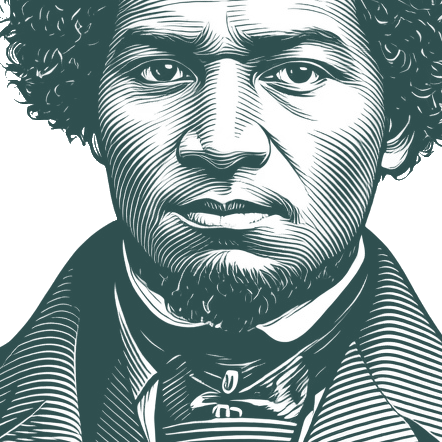
Bio from: Wikiquote (CC BY-SA 4.0) · Portrait adapted from: Wikimedia Commons, Engraved by J.C. Buttre from a daguerreotype. (Public domain / CC0)
Birth Name:
Frederick Augustus Washington Bailey
Alternative Names:
Frederick Augustus Washington Baly
•
Fred Bailey
•
Freddie Bailey
From Wikidata (CC0)

Showing quotes in randomized order to avoid selection bias. Click Popular for most popular quotes.
Works in ChatGPT, Claude, or Any AI
Add semantic quote search to your AI assistant via MCP. One command setup.
During the late contest for the Union, the air was full of 'nevers', every one of which was contradicted and put to shame by the result, and I doubt not that most of those we now hear in our troubled air will meet the same fate. It is probably well for us that some of our gloomy prophets are limited in their powers to prediction. Could they commend the destructive bolt, as readily as they commend the destructive word, it is hard to say what might happen to the country. They might fulfill their own gloomy prophecies. Of course it is easy to see why certain other classes of men speak hopelessly concerning us. A Government founded upon justice, and recognizing the equal rights of all men; claiming no higher authority for its existence, or sanction for its laws, than nature, reason and the regularly ascertained will of the people; steadily refusing to put its sword and purse in the service of any religious creed or family, is a standing offense to most of the governments of the world, and to some narrow and bigoted people among ourselves.
The south was not far behind the north in recognizing Abraham Lincoln as the natural leader of the rising political sentiment of the country against slavery, and it was equally quick in its efforts to counteract and destroy his influence. Its papers teemed with the bitterest invectives against the 'backwoodsman of Illinois', the 'flat-boatman', the 'rail-splitter', the 'third-rate lawyer', and much else and worse.
As nations are among the largest and the most complete divisions into which society is formed, the grandest aggregations of organized human power; as they raise to observation and distinction the world’s greatest men, and call into requisition the highest order of talent and ability for their guidance, preservation and success, they are ever among the most attractive, instructive and useful subjects of thought, to those just entering upon the duties and activities of life.
Works in ChatGPT, Claude, or Any AI
Add semantic quote search to your AI assistant via MCP. One command setup.
I dwell mostly upon the religious aspects, because I believe it is the religious people who are to be relied upon in this Anti-Slavery movement. Do not misunderstand my railing—do not class me with those who despise religion—do not identify me with the infidel. I love the religion of Christianity—which cometh from above—which is a pure, peaceable, gentle, easy to be entreated, full of good fruits, and without hypocrisy. I love that religion which sends its votaries to bind up the wounds of those who have fallen among thieves.
By all the love I bear such a Christianity as this, I hate that of the Priest and the Levite, that with long-faced Phariseeism goes up to Jerusalem to worship and leaves the bruised and wounded to die. I despise that religion which can carry Bibles to the heathen on the other side of the globe and withhold them from the heathen on this side—which can talk about human rights yonder and traffic in human flesh here.... I love that which makes its votaries do to others as they would that others should do to them. I hope to see a revival of it—thank God it is revived. I see revivals of it in the absence of the other sort of revivals. I believe it to be confessed now, that there has not been a sensible man converted after the old sort of way, in the last five years.
The State of Virginia is famous in American annals for the multitudinous array of her statesmen and heroes. She has been dignified by some the mother of statesmen. History has not been sparing in recording their names, or in blazoning their deeds. Her high position in this respect, has given her an enviable distinction among her sister States. With Virginia for his birth-place, even a man of ordinary parts, on account of the general partiality for her sons, easily rises to eminent stations. Men, not great enough to attract special attention in their native States, have, like a certain distinguished citizen in the State of New York, sighed and repined that they were not born in Virginia.
Fellow citizens, whatever else in this world may be partial, unjust, and uncertain, time, time! is impartial, just, and certain in its action. In the realm of mind, as well as in the realm of matter, it is a great worker, and often works wonders. The honest and comprehensive statesman, clearly discerning the needs of his country, and earnestly endeavoring to do his whole duty, though covered and blistered with reproaches, may safely leave his course to the silent judgment of time. Few great public men have ever been the victims of fiercer denunciation than Abraham Lincoln was during his administration. He was often wounded in the house of his friends. Reproaches came thick and fast upon him from within and from without, and from opposite quarters. He was assailed by Abolitionists; he was assailed by slave-holders; he was assailed by the men who were for peace at any price; he was assailed by those who were for a more vigorous prosecution of the war; he was assailed for not making the war an abolition war; and he was bitterly assailed for making the war an abolition war. But now behold the change. The judgment of the present hour is, that taking him for all in all, measuring the tremendous magnitude of the work before him, considering the necessary means to ends, and surveying the end from the beginning, infinite wisdom has seldom sent any man into the world better fitted for his mission than Abraham Lincoln. His birth, his training, and his natural endowments, both mental and physical, were strongly in his favor. Born and reared among the lowly, a stranger to wealth and luxury, compelled to grapple single-handed with the flintiest hardships of life, from tender youth to sturdy manhood, he grew strong in the manly and heroic qualities demanded by the great mission to which he was called by the votes of his countrymen. The hard condition of his early life, which would have depressed and broken down weaker men, only gave greater life, vigor, and buoyancy to the heroic spirit of Abraham Lincoln. He was ready for any kind and any quality of work. What other young men dreaded in the shape of toil, he took hold of with the utmost cheerfulness.
The whole history of the progress of human liberty shows that all concessions yet made to her august claims have been born of earnest struggle... If there is no struggle there is no progress. Those who profess to favor freedom and yet deprecate agitation are men who want crops without plowing up the ground; they want rain without thunder and lightning. They want the ocean without the awful roar of its many waters. This struggle may be a moral one, or it may be a physical one, and it may be both moral and physical, but it must be a struggle. Power concedes nothing without a demand. It never did and it never will. Find out just what any people will quietly submit to and you have found out the exact measure of injustice and wrong which will be imposed upon them, and these will continue till they are resisted with either words or blows, or with both. The limits of tyrants are prescribed by the endurance of those whom they oppress.
Such are the limitations of the human mind, and so thoroughly engrossing are the cares of common life, that only the few among men can discern through the glitter and dazzle of present prosperity the dark outlines of approaching disasters, even though they may have come up to our very gates, and are already within striking distance. The yawning seam and corroded bolt conceal their defects from the mariner until the storm calls all hands to the pumps. Prophets, indeed, were abundant before the war; but who cares for prophets while their predictions remain unfulfilled, and the calamities of which they tell are masked behind a blinding blaze of national prosperity?
Fellow-citizens, pardon me, allow me to ask, why am I called upon to speak here to-day? What have I, or those I represent, to do with your national independence? Are the great principles of political freedom and of natural justice, embodied in that Declaration of Independence, extended to us? And am I, therefore, called upon to bring our humble offering to the national altar, and to confess the benefits and express devout gratitude for the blessings resulting from your independence to us?
I am not included within the pale of this glorious anniversary! Your high independence only reveals the immeasurable distance between us. The blessings in which you this day rejoice are not enjoyed in common. The rich inheritance of justice, liberty, prosperity, and independence bequeathed by your fathers is shared by you, not by me. The sunlight that brought life and healing to you has brought stripes and death to me. This Fourth of July is yours, not mine. You may rejoice, I must mourn. To drag a man in fetters into the grand illuminated temple of liberty, and call upon him to join you in joyous anthems, were inhuman mockery and sacrilegious irony. Do you mean, citizens, to mock me, by asking me to speak today?
What, to the American slave, is your Fourth of July? I answer: a day that reveals to him, more than all other days of the year, the gross injustice and cruelty to which he is a constant victim. To him, your celebration is a sham; your boasted liberty, an unholy license; your national greatness, swelling vanity; your sounds of rejoicing are empty and heartless; your denunciation of tyrants, brass fronted impudence; your shouts of liberty and equality, hollow mockery; your prayers and hymns, your sermons and thanksgivings, with all your religious parade and solemnity, are, to Him, mere bombast, fraud, deception, impiety, and hypocrisy — a thin veil to cover up crimes that would disgrace a nation of savages. There is not a nation of the earth guilty of practices more shocki
We have for a long time hesitated to adopt and carry out the only principle which can solve that difficulty and give peace, strength and security to the republic, and that is the principle of absolute equality. We are a country of all extremes, ends and opposites. The most conspicuous example of composite nationality in the world. Our people defy all the ethnological and logical classifications. In races we range all the way from black to white, with intermediate shades which, as in the apocalyptic vision, no man can name or number.
To the mind of superficial men the future of different races has already brought disaster and ruin upon the country. The poor negro has been charged with all our woes. In the haste of these men they forget that our trouble was not ethnological, but moral, that it was not difference of complexion, but difference of conviction. It was not the Ethiopian as a man, but the Ethiopian as a slave and a coveted article of merchandise, that gave us trouble. I close these remarks as I began. If our action shall be in accordance with the principles of justice, liberty, and perfect human equality, no eloquence can adequately portray the greatness and grandeur of the future of the republic. We shall spread the network of our science and our civilization over all who seek their shelter, whether from Asia, Africa, or the isles of the sea. We shall mold them all, each after his kind, into Americans. Indian and Celt, Negro and Saxon, Latin and Teuton, Mongolian and Caucasian, Jew and gentile, all shall here bow to the same law, speak the same language, support the same government, enjoy the same liberty, vibrate with the same national enthusiasm, and seek the same national ends.