There was the time, shortly after the Supreme Court's decision in Roe versus Wade in 1973, when Cardinal Medeiros called Tip and asked to see him on a matter of great urgency. With some trepidation about the purpose of the visit, Tip agreed to see him right away. As it turned out, Cardinal Medeiros was extremely concerned about a powerful hurricane that had just devastated the Cape Verde Islands. He had a specific request for Tip--to see if $8 million in emergency relief could be included in the foreign aid appropriations bill. Tip, with that irrepressible twinkle in his eye, replied, "Your Eminence, I'll put $16 million in, if you won't mention Roe versus Wade." One of Tip's most famous stories concerned the gift by Henry Ford of $5,000 toward a new hospital in Ireland. Unfortunately, the local newspaper the next day reported that the gift was $50,000. The editor apologized profusely for the mistake, and said he'd run a correction right away, explaining that the gift was only $5,000. It took Henry Ford about 10 seconds to realize what was happening, and he said, "No, don't do that. I'll give you the $50,000, but on one condition--that you put a plaque over the entrance to the hospital with this inscription--'I came unto you, and you took me in.'"
United States Senator from Massachusetts from 1962 to 2009
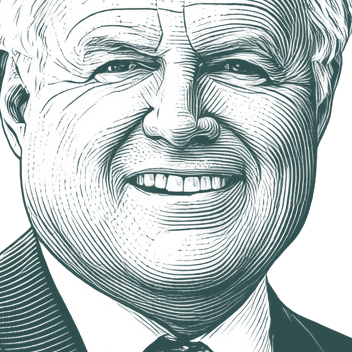
Edward Moore "Ted" Kennedy (22 February 1932 – 25 August 2009) was the senior Democratic U.S. senator from Massachusetts. In office from November 1962 to August 2009, Kennedy was, at the time, the second-longest serving member of the Senate, after Robert Byrd of West Virginia. He was the younger brother of John F. Kennedy and Robert F. Kennedy, and the uncle of Caroline Kennedy.
Bio from: Wikiquote (CC BY-SA 4.0) · Portrait adapted from: Wikimedia Commons, Ted_Kennedy,_official_photo_portrait.jpg: United States Senate derivative work: Tktru (talk) (Public domain / CC0)
Birth Name:
Edward Moore Kennedy
Native Name:
Edward Kennedy
Alternative Names:
Edward Moore "Ted" Kennedy
•
Edward M. Kennedy
From Wikidata (CC0)
Works in ChatGPT, Claude, or Any AI
Add semantic quote search to your AI assistant via MCP. One command setup.
At another Democratic convention, in arguing for this cause, I spoke of the insurance coverage senators and members of Congress provide for themselves. That was 1980. In the last year, I've often relied on that Congressional insurance. My wife, Vicki, and I have worried about many things, but not whether we could afford my care and treatment. Each time I've made a phone call or held a meeting about the health bill—or even when I've had the opportunity to get out for a sail along the Massachusetts coast—I've thought in an even more powerful way than before about what this will mean to others. And I am resolved to see to it this year that we create a system to ensure that someday, when there is a cure for the disease I now have, no American who needs it will be denied it.
We will bring health-care reform to the Senate and House floors soon, and there will be a vote. A century-long struggle will reach its climax. We're almost there. In the meantime, I will continue what I've been doing—making calls, urging progress. I've had dinner twice recently at my home in Hyannis Port with Senator Dodd, and when President Obama called me during his Rome trip after meeting with the Pope, much of our discussion was about health care. I believe the bill will pass, and we will end the disgrace of America as the only major industrialized nation in the world that doesn't guarantee health care for all of its people.
This would threaten not just the health of Americans but also the strength of the American economy. Health-care spending already accounts for 17 percent of our entire domestic product. In other advanced nations, where the figure is around 10 percent, everyone has insurance and health outcomes that are equal or better than ours. This disparity undermines our ability to compete and succeed in the global economy. General Motors spends more per vehicle on health care than on steel.
Try QuoteGPT
Chat naturally about what you need. Each answer links back to real quotes with citations.
I've heard the critics complain about the costs of change. I'm confident that at the end of the process, the change will be paid for—fairly, responsibly, and without adding to the federal deficit. It doesn't make sense to negotiate in the pages of NEWSWEEK, but I will say that I'm open to many options, including a surtax on the wealthy, as long as it meets the principle laid down by President Obama: that there will be no tax increases on anyone making less than $250,000 a year. What I haven't heard the critics discuss is the cost of inaction. If we don't reform the system, if we leave things as they are, health-care inflation will cost far more over the next decade than health-care reform. We will pay far more for far less—with millions more Americans uninsured or underinsured.
Another cardinal principle of reform: we have to make certain that people can keep the coverage they already have. Millions of employers already provide health insurance for their employees. We shouldn't do anything to disturb this. On the contrary, we need to mandate employer responsibility: except for small businesses with fewer than 25 employees, every company should have to cover its workers or pay into a system that will. We need to prevent disease and not just cure it. (Today 80 percent of health spending pays for care for the 20 percent of Americans with chronic illnesses like diabetes, cancer, or heart disease.) Too many people get to the doctor too seldom or too late—or know too little about how to stay healthy. No one knows better than I do that when it comes to advanced, highly specialized treatments, America can boast the best health care in the world—at least for those who can afford it. But we still have to modernize a system that doesn't always provide the basics.
All Americans should be required to have insurance. For those who can't afford the premiums, we can provide subsidies. We'll make it illegal to deny coverage due to preexisting conditions. We'll also prohibit the practice of charging women higher premiums than men, and the elderly far higher premiums than anyone else. The bill drafted by the Senate health committee will let children be covered by their parents' policy until the age of 26, since first jobs after high school or college often don't offer health benefits. To accomplish all of this, we have to cut the costs of health care. For families who've seen health-insurance premiums more than double—from an average of less than $6,000 a year to nearly $13,000 since 1999—one of the most controversial features of reform is one of the most vital. It's been called the "public plan." Despite what its detractors allege, it's not "socialism." It could take a number of different forms. Our bill favors a "community health-insurance option." In short, this means that the federal government would negotiate rates—in keeping with local economic conditions—for a plan that would be offered alongside private insurance options. This will foster competition in pricing and services. It will be a safety net, giving Americans a place to go when they can't find or afford private insurance, and it's critical to holding costs down for everyone.
To help finance a bill, the pharmaceutical industry has agreed to lower prices for seniors, not only saving them money for prescriptions but also saving the government tens of billions in Medicare payments over the next decade. Senator Baucus has agreed with hospitals on more than $100 billion in savings. We're working with Republicans to make this a bipartisan effort. Everyone won't be satisfied—and no one will get everything they want. But we need to come together, just as we've done in other great struggles—in World War II and the Cold War, in passing the great civil-rights laws of the 1960s, and in daring to send a man to the moon. If we don't get every provision right, we can adjust and improve the program next year or in the years to come. What we can't afford is to wait another generation.
Incremental measures won't suffice anymore. We need to succeed where Teddy Roosevelt and all others since have failed. The conditions now are better than ever. In Barack Obama, we have a president who's announced that he's determined to sign a bill into law this fall. And much of the business community, which has suffered the economic cost of inaction, is helping to shape change, not lobbying against it. I know this because I've spent the past year, along with my staff, negotiating with business leaders, hospital administrators, and doctors. As soon as I left the hospital last summer, I was on the phone, and I've kept at it. Since the inauguration, the administration has been deeply involved in the process. So have my Senate colleagues—in particular Max Baucus, the chair of the Finance Committee, and my friend and partner in this mission, Chris Dodd. Even those most ardently opposed to reform in the past have been willing to make constructive gestures now.
That didn't happen as soon as I thought it would. When Bill Clinton returned to the issue in the first years of his presidency, I fought the battle in Congress. We lost to a virtually united front of corporations, insurance companies, and other interest groups. The Clinton proposal never even came to a vote. But we didn't just walk away and do nothing—even though Republicans were again in control of Congress. We returned to a step-by-step approach. With Sen. Nancy Landon Kassebaum of Kansas, the daughter of the 1936 Republican presidential nominee, I crafted a law to make health insurance more portable for those who change or lose jobs. It didn't do enough to fully guarantee that, but we made progress. I worked with my friend Sen. Orrin Hatch of Utah, the Republican chair of our committee, to enact CHIP, the Children's Health Insurance Program; today it covers more than 7 million children from low-income families, although too many of them could soon lose coverage as impoverished state governments cut their contributions.
Some years later, I decided the time was right to renew the quest for universal and affordable coverage. When I first introduced the bill in 1970, I didn't expect an easy victory (although I never suspected that it would take this long). I eventually came to believe that we'd have to give up on the ideal of a government-run, single-payer system if we wanted to get universal care. Some of my allies called me a sellout because I was willing to compromise. Even so, we almost had a plan that President Richard Nixon was willing to sign in 1974—but that chance was lost as the Watergate storm swept Washington and the country, and swept Nixon out of the White House. I tried to negotiate an agreement with President Carter but became frustrated when he decided that he'd rather take a piecemeal approach. I ran against Carter, a sitting president from my own party, in large part because of this disagreement. Health reform became central to my 1980 presidential campaign: I argued then that the issue wasn't just coverage but also out-of-control costs that would ultimately break both family and federal budgets, and increasingly burden the national economy. I even predicted, optimistically, that the business community, largely opposed to reform, would come around to supporting it.
PREMIUM FEATURE
Advanced Search Filters
Filter search results by source, date, and more with our premium search tools.
For the next generation, no one ventured to tread where T.R. and Truman fell short. But in the early 1960s, a new young president was determined to take a first step—to free the elderly from the threat of medical poverty. John Kennedy called Medicare "one of the most important measures I have advocated." He understood the pain of injury and illness: as a senator, he had almost died after surgery to repair a back injury sustained during World War II, an injury that would plague him all of his life. I was in college as he recuperated and learned to walk without crutches at my parents' winter home in Florida. I visited often, and we spent afternoons painting landscapes and seascapes. (It was a competition: at dinner after we finished, we would ask family members to decide whose painting was better.) I saw how the pain would periodically hit him as we were painting; he'd have to put down his brush for a while. And I saw, too, how hard he fought as president to pass Medicare. It was a battle he didn't have the opportunity to finish. But I was in the Senate to vote for the Medicare bill before Lyndon Johnson signed it into law—with Harry Truman at his side. In the Senate, I viewed Medicare as a great achievement, but only a beginning. In 1966, I visited the Columbia Point Neighborhood Health Center in Boston; it was a pilot project providing health services to low-income families in the two-floor office of an apartment building. I saw mothers in rocking chairs, tending their children in a warm and welcoming setting. They told me this was the first time they could get basic care without spending hours on public transportation and in hospital waiting rooms. I authored legislation, which passed a few months later, establishing the network of community health centers that are all around America today.
Our response to these challenges will define our character as a country. But the challenges themselves—and the demands for reform—are not new. In 1912, when Theodore Roosevelt ran for a third term as president, the platform of his newly created Progressive Party called for national health insurance. Harry Truman proposed it again more than 30 years after Roosevelt was defeated. The plan was attacked, not for the last time, as "socialized medicine," and members of Truman's White House staff were branded "followers of the Moscow party line."