Hence we may at once dismiss as easily foreseen but futile objection, “that by our admitting the ideality of space and of time the whole sensible wor… - Immanuel Kant
""
Hence we may at once dismiss as easily foreseen but futile objection, “that by our admitting the ideality of space and of time the whole sensible world would be turned into mere illusion.
English
Collect this quote
About
Immanuel Kant
Immanuel Kant (22 April 1724 – 12 February 1804), born Emanuel Kant, was a German philosopher.
Biography information from
Wikiquote·
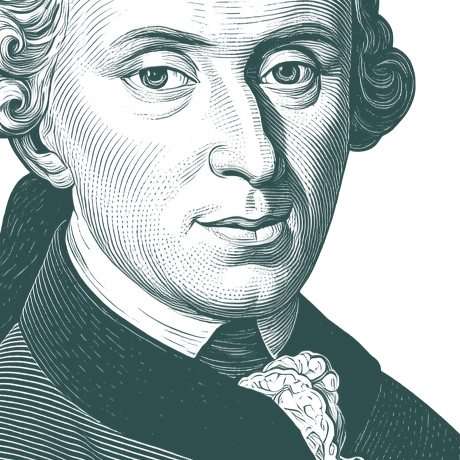
Portrait adapted from
Wikimedia Commons, Becker (Public domain / CC0)
I am an investigator by inclination. I feel a great thirst for knowledge and an impatient eagerness to advance, also satisfaction at each progressive step. There was a time when I thought that all this could constitute the honor of humanity, and I despised the mob, which knows nothing about it. Rousseau set me straight. This dazzling excellence vanishes; I learn to honor men, and would consider myself much less useful than common laborers if I did not believe that this consideration could give all the others a value, to establish the rights of humanity.
If it were right to overstep a little the limits of apodictic certainty befitting metaphysics, it would seem worth while to trace out some things pertaining not merely to the laws but even to the causes of sensuous intuition, which are only intellectually knowable. Of course the human mind is not affected by external things, and the world does not lie open to its insight infinitely, except as far as itself together with all other things is sustained by the same infinite power of one. Hence it does not perceive external things but by the presence of the same common sustaining cause; and hence space, which is the universal and necessary condition of the joint presence of everything known sensuously, may be called the phenomenal omnipresence, for the cause of the universe is not present to all things and everything, as being in their places, but their places, that is the relations of the substances, are possible, because it is intimately present to all. Furthermore, since the possibility of the changes and successions of all things whose principle as far as sensuously known resides in the concept of time, supposes the continuous existence of the subject whose opposite states succeed; that whose states are in flux, lasting not, however, unless sustained by another; the concept of time as one infinite and immutable in which all things are and last, is the phenomenal eternity of the general cause} But it seems more cautious to hug the shore of the cognitions granted to us by the mediocrity of our intellect than to be carried out upon the high seas of such mystic investigations, like Malebranche, whose opinion that we see all things in God is pretty nearly what has here been expounded.
Go Premium
Support Quotewise while enjoying an ad-free experience and premium features.