Again, it is absurd to hold that a man ought to be ashamed of being unable to defend himself with his limbs, but not of being unable to defend himself with speech and reason, when the use of rational speech is more distinctive of a human being than the use of his limbs. And if it be objected that one who uses such power of speech unjustly might do great harm, that is a charge which may be made in common against all good things except virtue, and above all against the things that are most useful, as strength, health, wealth, generalship. A man can confer the greatest of benefits by a right use of these, and inflict the greatest of injuries by using them wrongly.
4th-century BCE Classical Greek philosopher and polymath
Aristotle (Ἀριστοτέλης Aristotelēs; 384 BC – 322 BC) was a Greek philosopher and polymath during the Classical period in Ancient Greece. Taught by Plato, he was the teacher of Theophrastus and founder of the Lyceum, the Peripatetic school of philosophy, and the Aristotelian tradition. His writings cover many subjects including physics, biology, zoology, metaphysics, logic, ethics, aesthetics, poetry, theatre, music, rhetoric, psychology, linguistics, economics, politics, meteorology, geology and government. Aristotle provided a complex synthesis of the various philosophies existing prior to him. It was above all from his teachings that the West inherited its intellectual lexicon, as well as problems and methods of inquiry. As a result, his philosophy has exerted a unique influence on almost every form of knowledge in the West and it continues to be a subject of contemporary philosophical discussion.
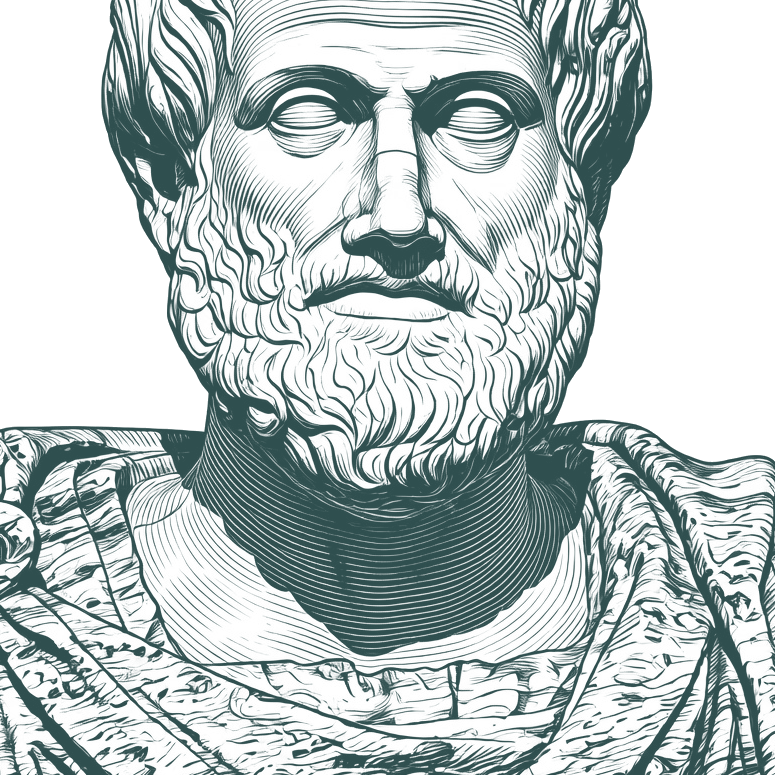
Bio from: Wikiquote (CC BY-SA 4.0) · Portrait adapted from: Wikimedia Commons, After Lysippos (Public domain / CC0)
Native Name:
Ἀριστοτέλης
Alternative Names:
the Stagirite
•
Aristotelis
•
Aristoteles
From Wikidata (CC0)
Showing quotes in randomized order to avoid selection bias. Click Popular for most popular quotes.
Try QuoteGPT
Chat naturally about what you need. Each answer links back to real quotes with citations.
And surely to know what this good is, is of great importance for the conduct of life, for in that case we shall be like archers shooting at a definite mark, and shall be more likely to do what is right. But, if this is the case, we must try to comprehend, in outline at least, what it is and to which of the sciences it belongs. (Bk I, Ch I)
Enhance Your Quote Experience
Enjoy ad-free browsing, unlimited collections, and advanced search features with Premium.
For it is owing to their wonder that men both now begin and at first began to philosophize; they wondered originally at the obvious difficulties, then advanced little by little and stated difficulties about the greater matters, e.g. about the phenomena of the moon and those of the sun and of the stars, and about the genesis of the universe. And a man who is puzzled and wonders thinks himself ignorant (whence even the lover of myth is in a sense a lover of Wisdom, for the myth is composed of wonders); therefore since they philosophized order to escape from ignorance, evidently they were pursuing science in order to know, and not for any utilitarian end. — Metaphysics by Aristotle – Book 1, ClassicalWisdom.com
All men by nature desire to know. An indication of this is the delight we take in our senses; for even apart from their usefulness they are loved for themselves; and above all others the sense of sight. For not only with a view to action, but even when we are not going to do anything, we prefer seeing (one might say) to everything else. The reason is that this, most of all the senses, makes us know and brings to light many differences between things.
Limited Time Offer
Premium members can get their quote collection automatically imported into their Quotewise collections.