According to one mode... nature is thus denominated, viz. the first subject matter to every thing which contains in itself the principle of motion an… - Aristotle
""
According to one mode... nature is thus denominated, viz. the first subject matter to every thing which contains in itself the principle of motion and mutation. But after another mode it is denominated form, which subsists according to definition: for as art is called that which subsists according to art, and that which is artificial; so likewise nature is both called that which is according to nature, and that which is natural. ...that which is composed from these is not nature, but consists from nature; as, for instance, man. And this is nature in a greater degree than matter: for every thing is then said to be, when it is form in energy... entelecheia, rather than when it is incapacity.
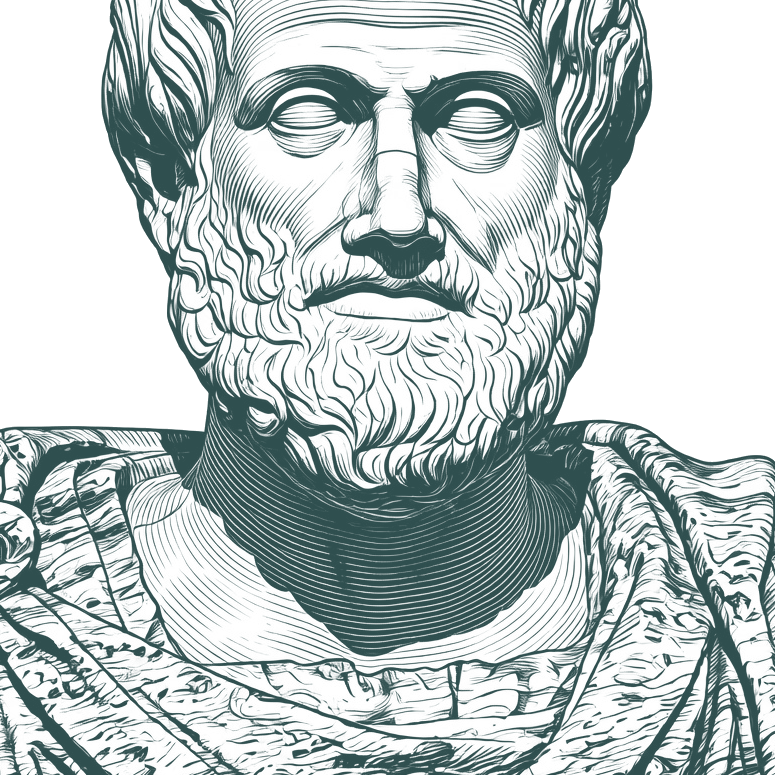
Aristotle (Ἀριστοτέλης Aristotelēs; 384 BC – 322 BC) was a Greek philosopher and polymath during the Classical period in Ancient Greece. Taught by Plato, he was the teacher of Theophrastus and founder of the Lyceum, the Peripatetic school of philosophy, and the Aristotelian tradition. His writings cover many subjects including physics, biology, zoology, metaphysics, logic, ethics, aesthetics, poetry, theatre, music, rhetoric, psychology, linguistics, economics, politics, meteorology, geology and government. Aristotle provided a complex synthesis of the various philosophies existing prior to him. It was above all from his teachings that the West inherited its intellectual lexicon, as well as problems and methods of inquiry. As a result, his philosophy has exerted a unique influence on almost every form of knowledge in the West and it continues to be a subject of contemporary philosophical discussion.
Biography information from
Wikiquote·
Portrait adapted from
Wikimedia Commons, After Lysippos (Public domain / CC0)
Also Known As
Native Name:
Ἀριστοτέλης
Alternative Names:
the Stagirite
•
Aristotelis
•
Aristoteles
It is proper for the magnanimous person to ask for nothing, or hardly anything, but to help eagerly.
Hence a young man is not a proper hearer of lectures on political science; for he is inexperienced in the actions that occur in life, but its discussions start from these and are about these; and, further, since he tends to follow his passions, his study will be vain and unprofitable, because the end aimed at is not knowledge but action. And it makes no difference whether he is young in years or youthful in character; the defect does not depend on time, but on his living, and pursuing each successive object, as passion directs. For to such persons, as to the incontinent, knowledge brings no profit; but to those who desire and act in accordance with a rational principle knowledge about such matters will be of great benefit.
Enhance Your Quote Experience
Enjoy ad-free browsing, unlimited collections, and advanced search features with Premium.