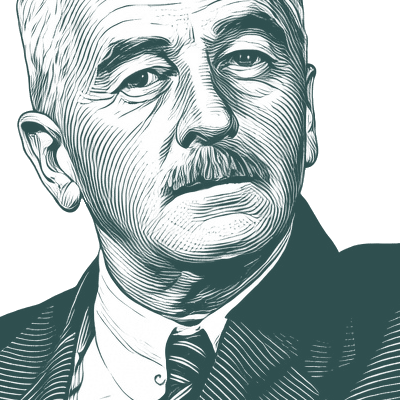
In the afternoon when school was out and the last one had left with his little dirty snuffling nose, instead of going home I would go down the hill t… - William Faulkner

" "

In the afternoon when school was out and the last one had left with his little dirty snuffling nose, instead of going home I would go down the hill to the spring where I could be quiet and hate them.

English
Collect this quote

About William Faulkner

William Cuthbert Faulkner (September 25, 1897 – July 6, 1962) was an American novelist and short story writer whose works feature his native state of Mississippi. He was regarded as one of the most influential writers of the twentieth century and was awarded the 1949 Nobel Prize for Literature.

Biography information from Wikiquote

Also Known As

Birth Name: William Cuthbert Falkner
Native Name: William Cuthbert Faulkner
Alternative Names: William Falkner
Works in ChatGPT, Claude, or Any AI

Add semantic quote search to your AI assistant via MCP. One command setup.

Related quotes. More quotes will automatically load as you scroll down, or you can use the load more buttons.

Additional quotes by William Faulkner

That was when I learned that words are no good; that words dont ever fit even what they are trying to say at. When he was born I knew that motherhood was invented by someone who had to have a word for it because the ones that had the children didn't care whether there was a word for it or not. I knew that fear was invented by someone that had never had the fear; pride, who never had the pride.

Try QuoteGPT

Chat naturally about what you need. Each answer links back to real quotes with citations.

Ladies and gentlemen,

I feel that this award was not made to me as a man, but to my work - a life's work in the agony and sweat of the human spirit, not for glory and least of all for profit, but to create out of the materials of the human spirit something which did not exist before. So this award is only mine in trust. It will not be difficult to find a dedication for the money part of it commensurate with the purpose and significance of its origin. But I would like to do the same with the acclaim too, by using this moment as a pinnacle from which I might be listened to by the young men and women already dedicated to the same anguish and travail, among whom is already that one who will some day stand here where I am standing.

Our tragedy today is a general and universal physical fear so long sustained by now that we can even bear it. There are no longer problems of the spirit. There is only the question: When will I be blown up? Because of this, the young man or woman writing today has forgotten the problems of the human heart in conflict with itself which alone can make good writing because only that is worth writing about, worth the agony and the sweat.

He must learn them again. He must teach himself that the basest of all things is to be afraid; and, teaching himself that, forget it forever, leaving no room in his workshop for anything but the old verities and truths of the heart, the old universal truths lacking which any story is ephemeral and doomed - love and honor and pity and pride and compassion and sacrifice. Until he does so, he labors under a curse. He writes not of love but of lust, of defeats in which nobody loses anything of value, of victories without hope and, worst of all, without pity or compassion. His griefs grieve on no universal bones, leaving no scars. He writes not of the heart but of the glands.

Until he relearns these things, he will write as though he stood among and watched the end of man. I decline to accept the end of man. It is

Loading...