He fixed his definition thus: reflection is the possibility of the relation, consciousness is the relation, the first form of which is contradiction.… - Søren Kierkegaard
""
He fixed his definition thus: reflection is the possibility of the relation, consciousness is the relation, the first form of which is contradiction. He soon noted that, as a result, the categories of reflection are always dichotomous. For example ideality and reality, soul and body, to recognize – the true, to will – the good, to love – the beautiful, God and the world, and so on, these are categories of reflection. In reflection, these touch each other in such a way that a relation becomes possible. The categories of consciousness, on the other hand, are trichotomous, as language itself indicates, for when I say I am conscious of this, I mention a trinity. Consciousness is mind and spirit, and the remarkable thing is that when in the world of mind or spirit one is divided, it always becomes three and never two. Consciousness, therefore, presupposes reflection. If this were not true it would be impossible to explain doubt. True, language seems to contest this, since in most languages, as far as he knew, the word ‘doubt’ is etymologically related to the word ‘two’. Yet in his opinion this only indicated the presupposition of doubt, especially because it was clear to him that as soon as I, as spirit, become two, I am eo ipso three. If there were nothing but dichotomies, doubt would not exist, for the possibility of doubt lies precisely in that third which places the two in relation to each other. One cannot therefore say that reflection produces doubt, unless one expressed oneself backwards; one must say that doubt presupposes reflection, though not in a temporal sense. Doubt arises through a relation between two, but for this to take place the two must exist, although doubt, as a higher expression, comes before rather than afterwards."
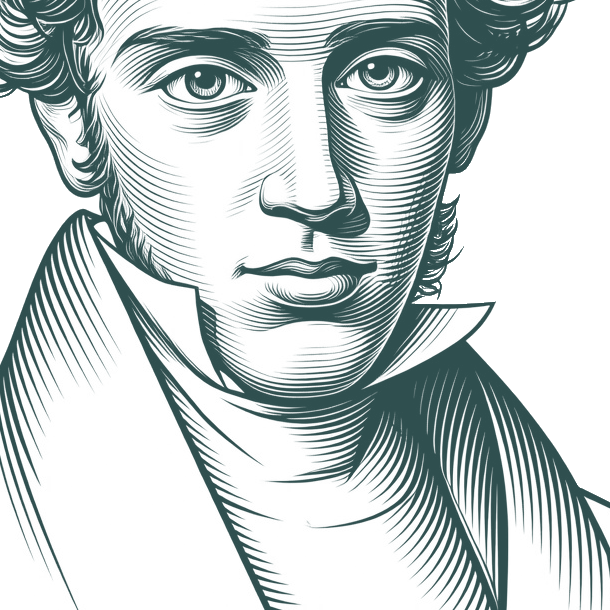
Søren Aabye Kierkegaard (5 May 1813 – 11 November 1855) was a Danish Christian philosopher and theologian, considered to be a founder of Existentialist thought and Absurdist traditions. He wrote critical texts on organized religion, Christendom, morality, ethics, psychology and philosophy of religion, displaying a fondness for metaphor, irony and parables.
Biography information from
Wikiquote·
Portrait adapted from
Wikimedia Commons, La Biblioteca Real de Dinamarca (Public domain / CC0)
Also Known As
Pen Names:
Victor Eremita
•
A
•
Judge William
•
Johannes de silentio
•
Constantine Constantius
•
Young Man
•
Vigilius Haufniensis
•
Nicolaus Notabene
•
Hilarius Bookbinder
•
Johannes Climacus
•
Inter et Inter
•
H.H.
•
Anti-Climacus
•
B
•
Johannes de Silentio
•
Constantin Constantius
•
P. CH. Kierkegaard
Native Name:
Søren Aabye Kierkegaard
Alternative Names:
Kierkegaard
•
Climacus
•
Sören Aaby Kierkegaard
The life-giving Spirit is the very one who slays you; the first thing the life-giving Spirit says is that you must enter into death, that you must die to – it is this way in order that you many not take Christianity in vain. A life-giving Spirit – that is the invitation; who would not willingly take hold of it! But die first – that is the halt!
No one shall be forgotten who was great in this world; but everyone was great in his own way, and everyone in proportion to the greatness of what he loved.
Limited Time Offer
Premium members can get their quote collection automatically imported into their Quotewise collections.
With respect to love we speak continually about perfection and the perfect person. With respect to love Christianity also speaks continually about perfection and the perfect person. Alas, but we men talk about finding the perfect person in order to love him. Christianity speaks about being the perfect person who limitlessly loves the person he sees.