I have no idea whether parents can be of help, and I do not blame mine. It was my own affair to come to terms with myself and to find my own way, and like most well-brought-up children, I managed it badly.
Everyone goes through this crisis. For the average person this is the point when the demands of his own life come into the sharpest conflict with his environment, when the way forward has to be sought with the bitterest means at his command. Many people experience the dying and rebirth - which is our fate - only this once during their entire life. Their childhood becomes hollow and gradually collapses, everything they love abandons them and they suddenly feel surrounded by the loneliness and mortal cold of the universe. Very many are caught forever in this impasse, and for the rest of their lives cling painfully to an irrevocable past, the dream of the lost paradise - which is the worst and most ruthless of dreams.
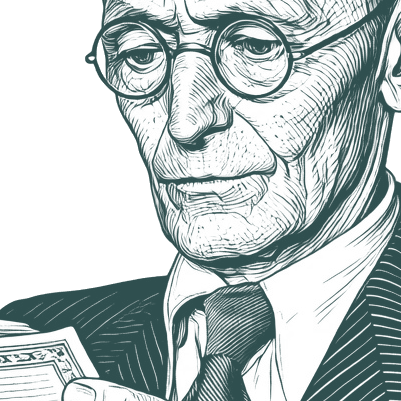
Nobel Prize winning German-Swiss poet, novelist and painter (1877–1962)
Hermann Karl Hesse (2 July 1877 – 9 August 1962) was a German-Swiss poet, novelist, and painter. In 1946, he received the Nobel Prize in Literature. His most famous works include Steppenwolf, Siddhartha, and The Glass Bead Game (also known as Magister Ludi) all of which explore an individual's search for spirituality.
Bio from: Wikiquote (CC BY-SA 4.0) · Portrait adapted from: Wikimedia Commons (CC BY-SA)
Native Name:
Hermann Karl Hesse
Alternative Names:
Hh. Hesse
•
Herman Hesse
From Wikidata (CC0)
Showing quotes in randomized order to avoid selection bias. Click Popular for most popular quotes.
Even centuries ago the members and historians of our League recognised and courageously faced up to this difficulty. One of the greatest of them gave expression to it in an immortal verse: He who travels far will often see things Far removed from what he believed was Truth. When he talks about it in the fields at home, He is often accused of lying, For the obdurate people will not believe What they do not see and distinctly feel. Inexperience, I believe. Will give little credence to my song. p. 8
Enhance Your Quote Experience
Enjoy ad-free browsing, unlimited collections, and advanced search features with Premium.
I sensed in it a spirit of specialism and virtuosity, certainly highly cultivated, certainly richly elaborated, but nevertheless isolated from humanity and the whole of life — a spirit that had soared too high into haughty solitariness. For years I doubted and probed, until the decision had matured within me and in spite of everything I decided in favor of the Game. I did so because I had within me that urge to seek the supreme fulfillment and serve only the greatest master.
The paradox alone must always be accepted that the seemingly impossible must continually be attempted. I agree with Siddhartha, our wise friend from the East, who once said: Words do not express thoughts very well; everything immediately becomes a little different, a little distorted, a little foolish. And yet it also pleases me and seems right that what is of value and wisdom to one man seems nonsense to another. p. 7
O how incomprehensible everything was, and actually sad, although it was also beautiful. One knew nothing. One lived and ran about the earth and rode through forests, and certain things looked so challenging and promising and nostalgic: a star in the evening, a blue harebell, a reed-green pond, the eye of a person or a cow. And sometimes it seemed that something never seen yet long desired was about to happen, that a veil would drop from it all, but then it passed, nothing happened, the riddle remained unsolved, the secret spell unbroken, and in the end one grew old and looked cunning . . . or wise . . . and still one knew nothing perhaps, was still waiting and listening.
The lone wolf who knows no peace, these victims of unceasing pain to whom the urge for tragedy has been denied and who can never break through the starry space, who feel themselves summoned thither and yet cannot survive in its atmosphere-for them is reserved, provided suffering has made their spirits rough and elastic enough, a way of reconcilement and an escape into humor. Humor has always something bourgeois in it, although the true bourgeois in capable of understanding it.
The realization that my problem was one that concerned all men, a problem of living and thinking, suddenly swept over me and I was overwhelmed by fear and respect as I suddenly saw and felt how deeply my own personal life and opinions were immersed in the eternal stream of great ideas. Though it offered some confirmation and gratification, the realization was not really a joyful one. It was hard and had a harsh taste because it implied responsibility and no longer being allowed to be a child; it meant standing on one’s own feet.