When I have neither pleasure nor pain and have been breathing for a while the lukewarm insipid air of these so called good and tolerable days, I feel so bad in my childish soul that I smash my moldering lyre of thanksgiving in the face of the slumbering god of contentment and would rather feel the very devil burn in me than this warmth of a well-heated room. A wild longing for strong emotions and sensations seethes in me, a rage against this toneless, flat, normal and sterile life. I have a mad impulse to smash something, a warehouse, perhaps, or a cathedral, or myself, to commit outrages, to pull off the wigs of a few revered idols...
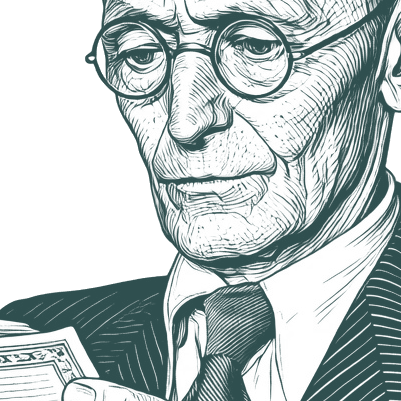
Nobel Prize winning German-Swiss poet, novelist and painter (1877–1962)
Hermann Karl Hesse (2 July 1877 – 9 August 1962) was a German-Swiss poet, novelist, and painter. In 1946, he received the Nobel Prize in Literature. His most famous works include Steppenwolf, Siddhartha, and The Glass Bead Game (also known as Magister Ludi) all of which explore an individual's search for spirituality.
Bio from: Wikiquote (CC BY-SA 4.0) · Portrait adapted from: Wikimedia Commons (CC BY-SA)
Native Name:
Hermann Karl Hesse
Alternative Names:
Hh. Hesse
•
Herman Hesse
From Wikidata (CC0)

Showing quotes in randomized order to avoid selection bias. Click Popular for most popular quotes.
There is, so I believe, in the essence of everything, something that we cannot call learning. There is, my friend, only a knowledge — that is everywhere, that is Atman, that is in me and you and in every creature, and I am beginning to believe that this knowledge has no worse enemy than the man of knowledge, than learning.
PREMIUM FEATURE
Advanced Search Filters
Filter search results by source, date, and more with our premium search tools.
When I have neither pleasure nor pain and have been breathing for a while the lukewarm insipid air of these so-called good and tolerable days, I feel so bad in my childish soul that I smash my rusty lyre of thanksgiving in the face of the slumbering god of contentment and would rather feel the most devilish pain burn in me than this warmth of a well-heated room.
- Harry Haller
Isolated here in the North, planted long ago by a Roman pilgrim, a chestnut grew, strong and solitary, by the colonnade of rounded double arches at the entrance to the cloister of Mariabronn: a noble, vigorous tree, the sweep of its foliage drooping tenderly, facing the winds in bold and quiet assurance; so tardy in spring that when all glowed green around it and even the cloister nut trees wore their russet, it awaited the shortest nights to thrust forth, through little tufts of leaves, the dim exotic rays of its blossom, and in October, after wine and harvests had long been gathered, let drop the prickly fruits from its yellowing crown... The lovely tree, aloof and tender, shadowed the entrance to the cloister, a delicate, shuddering guest from a warmer clime, secretly akin to the slender double columns of the gateway, the pillars and mouldings of the window arches, loved by all Latins and Italians, gaped at, as a stranger, by the inhabitants. Ch. I
I cannot understand nor share these joys, though they are within my reach, for which thousands of others strive. On the other hand, what happens to me in my rare hours of joy, what for me is bliss and life and ecstasy and exaltation, the world in general seeks at most in imagination; in life it finds it absurd. And in fact, if the world is right, if this music of the cafés, these mass enjoyments and these Americanised men who are pleased with so little are right, then I am wrong, I am crazy. I am in truth the Steppenwolf that I often call myself; that beast astray who finds neither home nor joy nor nourishment in a world that is strange and incomprehensible to him.
Limited Time Offer
Premium members can get their quote collection automatically imported into their Quotewise collections.
All being, it seemed, was built on opposites, on division. Man or woman, vagabond or citizen, lover or thinker — no breath could both be in and out, none could be man and wife, free and yet orderly, knowing the urge of life and the joy of intellect. Always the one paid for the other, though each was equally precious and essential.