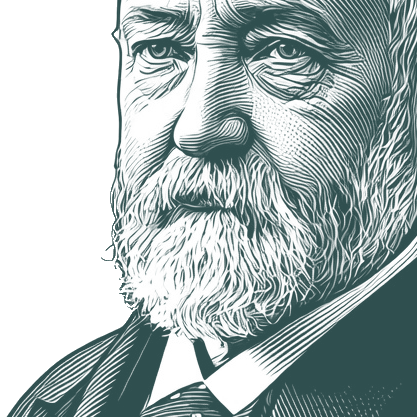
There is no constitutional or legal requirement that the President shall take the oath of office in the presence of the people, but there is so manif… - Benjamin Harrison
""
There is no constitutional or legal requirement that the President shall take the oath of office in the presence of the people, but there is so manifest an appropriateness in the public induction to office of the chief executive officer of the nation that from the beginning of the Government the people, to whose service the official oath consecrates the officer, have been called to witness the solemn ceremonial. The oath taken in the presence of the people becomes a mutual covenant. The officer covenants to serve the whole body of the people by a faithful execution of the laws, so that they may be the unfailing defense and security of those who respect and observe them, and that neither wealth, station, nor the power of combinations shall be able to evade their just penalties or to wrest them from a beneficent public purpose to serve the ends of cruelty or selfishness.
English
Collect this quote
About
Benjamin Harrison
Benjamin Harrison (20 August 1833 – 13 March 1901) was the 23rd president of the United States (1889–1893); he was the grandson of the ninth president, William Henry Harrison. Before ascending to the presidency, Harrison established himself as a prominent local attorney, Presbyterian church leader and politician in Indianapolis, Indiana. During the American Civil War, he served the Union as a colonel and on February 14, 1865 was confirmed by the U.S. Senate as a brevet brigadier general of volunteers to rank from January 23, 1865. After the war, he unsuccessfully ran for the governorship of Indiana. He was later elected to the U.S. Senate by the Indiana legislature.
Biography information from
Wikiquote·
Portrait adapted from
Wikimedia Commons, Pach Brothers (Public domain / CC0)
Also Known As
Alternative Names:
B. Harrison
•
President Harrison
It has been the hope of every patriot that a sense of justice and of respect for the law would work a gradual cure of these flagrant evils. Surely no one supposes that the present can be accepted as a permanent condition. If it is said that these communities must work out this problem for themselves, we have a right to ask whether they are at work upon it. Do they suggest any solution?
Shall the prejudices and paralysis of slavery continue to hang upon the skirts of progress? How long will those who rejoice that slavery no longer exists cherish or tolerate the incapacities it put upon their communities? I look hopefully to the continuance of our protective system and to the consequent development of manufacturing and mining enterprises in the States hitherto wholly given to agriculture as a potent influence in the perfect unification of our people. The men who have invested their capital in these enterprises, the farmers who have felt the benefit of their neighborhood, and the men who work in shop or field will not fail to find and to defend a community of interest.
PREMIUM FEATURE
Advanced Search Filters
Filter search results by source, date, and more with our premium search tools.
Is it not quite possible that the farmers and the promoters of the great mining and manufacturing enterprises which have recently been established in the South may yet find that the free ballot of the workingman, without distinction of race, is needed for their defense as well as for his own? I do not doubt that if those men in the South who now accept the tariff views of Clay and the constitutional expositions of Webster would courageously avow and defend their real convictions they would not find it difficult, by friendly instruction and cooperation, to make the black man their efficient and safe ally, not only in establishing correct principles in our national administration, but in preserving for their local communities the benefits of social order and economical and honest government. At least until the good offices of kindness and education have been fairly tried the contrary conclusion can not be plausibly urged.