The Mohamedan or Islamic culture hardly gave anything to the world which may said to be of fundamental importance and typically its own; Islamic cult… - Aurobindo Ghosh
""
The Mohamedan or Islamic culture hardly gave anything to the world which may said to be of fundamental importance and typically its own; Islamic culture was mainly borrowed from others. Their mathematics and astronomy and other subjects were derived from Greece. It is true they gave some of these things a new turn, but they have not created much. Their philosophy and their religion are very simple and what they call Sufism is largely the result of gnostics who lived in Persia and it is the logical outcome of that school of thought largely touched by Vedanta. [Except for Indo-Saracenic architecture]. I do not think it has done anything more in India of cultural value. It gave some new forms to art and poetry. Its political institutions were always semi-barbaric.
English
Collect this quote
About
Aurobindo Ghosh
Sri Aurobindo [born Aravinda Akroyd Ghose] (15 August 1872 – 5 December 1950) was an Indian nationalist, scholar, poet, mystic, philosopher, yogi and guru, who developed concepts of human progress and spiritual evolution. With the help of his spiritual collaborator, Mirra Alfassa, he founded the Sri Aurobindo Ashram.
Biography information from
Wikiquote·
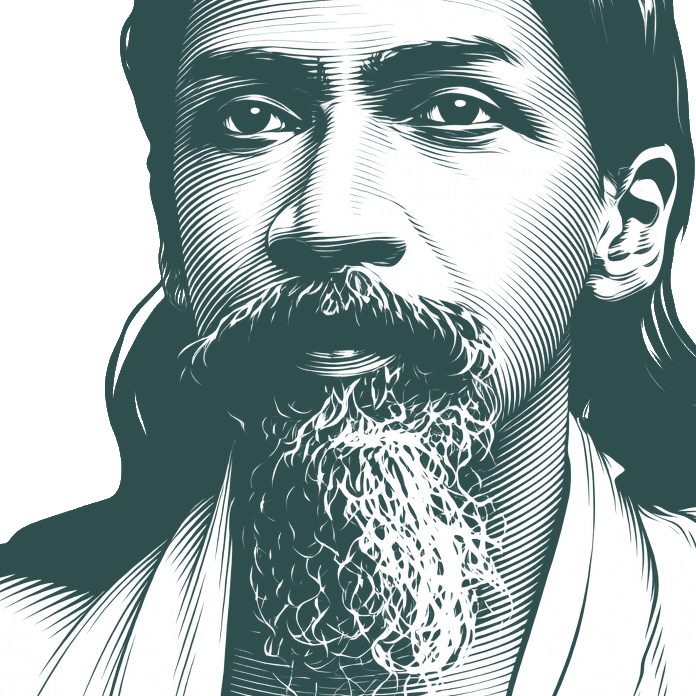
Portrait adapted from
Wikimedia Commons, Rudolf 1922 (Public domain / CC0)
Also Known As
Native Name:
অরবিন্দ ঘোষ
Alternative Names:
Sri Aurobindo Ghose
•
Sri Orobindo
•
Orobindo Ghosh
•
Shri Aurobindo
•
Aurobindo Ghose
•
Sri Aurobindo
•
Aurobindo
•
Aravinda Ackroyd Ghose
•
A.A.Ghosh
•
A.G.
•
Maharshi Aravind Babu
The fundamental idea of all Indian religion is one common to the highest human thinking everywhere. The supreme truth of all that is is a Being or an existence beyond the mental and physical appearances we contact here. Beyond mind, life and body there is a Spirit and Self containing all that is finite and infinite, surpassing all that is relative, a supreme Absolute, originating and supporting all that is transient, a one Eternal. A one transcendent, universal, original and sempiternal Divinity or divine Essence, Consciousness, Force and Bliss is the fount and continent and inhabitant of things. Soul, nature, life are only a manifestation or partial phenomenon of this self-aware Eternity and this conscious Eternal.
"You can live amicably with a religion whose principle is toleration. But how is it possible to live peacefully with a religion whose principle is "I will not tolerate you'? How are you going to have unity with these people. Certainly, Hindu-Muslim unity cannot be arrived at on the basis that the Muslims will go on converting Hindus while the Hindus shall not convert any Mohamedan.
The spiritual life (adhyatma-jivana), the religious life (dharma-jivana) and the ordinary human life of which morality is a part are three quite different things and one must know which one desires and not confuse the three together.
The ordinary life is that of the average human consciousness separated from its own true self and from the Divine and led by the common habits of the mind, life and body which are the laws of the Ignorance.
The religious life is a movement of the same ignorant human consciousness, turning or trying to turn away from the earth towards the Divine, but as yet without knowledge and led by the dogmatic tenets and rules of some sect or creed which claims to have found the way out of the bonds of the earth-consciousness into some beatific Beyond. The religious life may be the first approach to the spiritual, but very often it is only a turning about in a round of rites, ceremonies and practices or set ideas and forms without any issue.
The spiritual life, on the contrary, proceeds directly by a change of consciousness, a change from the ordinary consciousness, ignorant and separated from its true self and from God, to a greater consciousness in which one finds one's true being and comes first into direct and living contact and then into union with the Divine. For the spiritual seeker this change of consciousness is the one thing he seeks and nothing else matters.