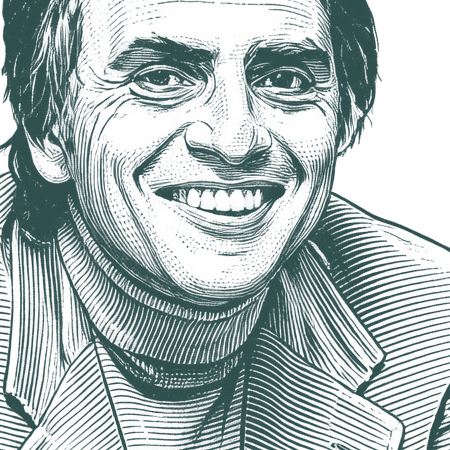
There are naive questions, tedious questions, ill-phrased questions, questions put after inadequate self-criticism. But every question is a cry to un… - Carl Sagan
""
There are naive questions, tedious questions, ill-phrased questions, questions put after inadequate self-criticism. But every question is a cry to understand the world. There is no such thing as a dumb question.
Carl Edward Sagan (9 November 1934 – 20 December 1996) was an American astronomer, planetary scientist, cosmologist, astrophysicist, astrobiologist, author, and science communicator. His best known scientific contribution is research on extraterrestrial life, including experimental demonstration of the production of amino acids from basic chemicals by radiation. Sagan assembled the first physical messages sent into space, the Pioneer plaque and the Voyager Golden Record, universal messages that could potentially be understood by any extraterrestrial intelligence that might find them. Sagan argued the hypothesis, accepted since, that the high surface temperatures of Venus can be attributed to, and calculated using, the greenhouse effect. He testified to the US Congress in 1985 that the greenhouse effect will change the earth's climate system.
Biography information from
Wikiquote·
Portrait adapted from
Wikimedia Commons, NASA/JPL (Public domain / CC0)
Also Known As
Native Name:
Carl Edward Sagan
Alternative Names:
Sagan
•
Carl E. Sagan
•
Carl E Sagan
•
C. E. Sagan
•
C.E. Sagan
•
C E Sagan
•
C. Sagan
•
C Sagan
•
Sagan C
•
Sagan C.
•
Sagan C. E.
•
Sagan CE
Science is an ongoing process. It never ends. There is no single ultimate truth to be achieved, after which all the scientists can retire. And because this is so, the world is far more interesting, both for the scientists and for the millions of people in every nation who, while not professional scientists, are deeply interested in the methods and findings of science.
it does not become us to be so curious and inquisitive in these Things which the Supreme Creator seems to have kept for his own Knowledge: For since he has not been pleased to make any farther Discovery or Revelation of them, it seems little better than presumption to make any inquiry into that which he has thought fit to hide. But these Gentlemen must be told,
Enhance Your Quote Experience
Enjoy ad-free browsing, unlimited collections, and advanced search features with Premium.
Kao što stari mitovi govore, mi smo jednako djeca neba i Zemlje. Kroz vrijeme svog boravka na ovom planetu sakupili smo opasno evolucijsko breme, naslijeđene sklonosti prema agresiji i ritualu, podčinjavanje vođama, mržnju prema strancima, što sve sada dovodi u pitanje naše preživljavanje. Ali stekli smo suosjećanje za druge, ljubav prema djeci i djeci naše djece, želju da učimo iz povijesti i uzvišenu strastvenu inteligenciju – očito oružje našeg preživljavanja i napretka. Koji će oblici naše prirode prevladati nesigurno je, posebno ako su naši pogledi, razumijevanje i vidici vezani isključivo za Zemlju – ili, još gore, za jedan mali dio nje. Ali tamo gore u beskraju svemira očekuje nas neizbježna budućnost. Za sada nema još nikakvih sigurnih signala izvanzemaljske inteligencije i stoga se pitamo da li civilizacije poput naše uvijek srljaju neumoljivo, nepromišljeno, prema samouništenju. Nacionalne granice su nezamjetljive kada Zemlju gledamo iz prostora. Fanatični etnički, religijski, nacionalni šovinizmi teško se mogu održati kada promatramo naš planet kao nježan plavi polumjesec kako se gasi poput sve slabije točke svjetlosti usred zvjezdanog tkanja. Putovanja proširuju vidike.