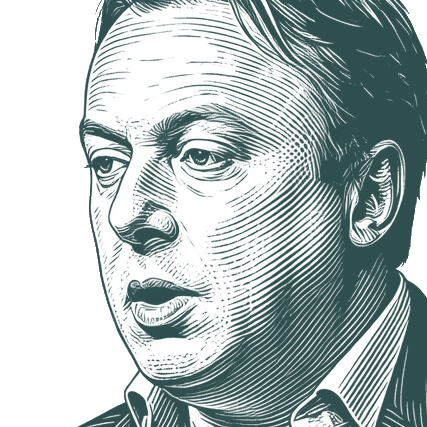
We find that the presidency has become too secretive, too powerful, too trammelled, too ceremonial, too impotent or too complicated, depending on the… - Christopher Hitchens
""
We find that the presidency has become too secretive, too powerful, too trammelled, too ceremonial, too impotent or too complicated, depending on the president under discussion or the critic making the analysis. On one thing all are agreed - there is a danger of an 'imperial' or 'monarchical' presidency. An incumbent in Washington knows he is in trouble on the day that cartoonists begin to represent him as a king.
Christopher Eric Hitchens (13 April 1949 – 15 December 2011) was an-English-American journalist and writer. He contributed to the New Statesman, The Nation, The Atlantic, London Review of Books, The Times Literary Supplement, Slate, and Vanity Fair. Hitchens was the author, co-author, editor or co-editor of over 30 books, including five collections of essays, on a range of subjects, including politics, literature, and religion. A staple of talk shows and lecture circuits, his confrontational style of debate made him both a lauded and controversial figure and public intellectual.
If someone tells me that I've hurt their feelings, I say, 'I'm still waiting to hear what your point is.'
In this country, I've been told, 'That's offensive' as if those two words constitute an argument or a comment. Not to me they don't.
And I'm not running for anything, so I don't have to pretend to like people when I don't.
We know that the enemies of our civilization and of Arab-Muslim civilization have emerged from what is actually a root cause. The root cause is the political slum of client states from Saudi Arabia through Iraq, Pakistan and elsewhere, that has been allowed to dominate the region under U.S. patronage, and uses people and resources as if they were a gas station with a few flyblown attendants. To the extent that this policy, this mentality, has now changed in the administration, to the extent that their review of that is sincere and the conclusions that they draw from it are sincere, I think that should be welcomed. It's a big improvement to be intervening in Iraq against Saddam Hussein instead of in his favor. I think it makes a nice change. It's a regime change for us too. Now I'll state what I think is gonna happen. I've been in London and Washington a lot lately and all I can tell you is that the spokesmen for Mr. Blair and Mr. Bush walk around with a look of extraordinary confidence on their faces, as if they know something that when disclosed, will dissolve the doubts, the informational doubts at any rate, of people who wonder if there is enough evidence. [Mark Danner: It's amazing they've been able to keep it to themselves for so long.] I simply say, I have two reasons for confidence. I know perfectly well that there are many people who would not be persuaded by this evidence even if it was dumped on their own doorstep, because the same people, many of the same people, didn't believe that it was worth fighting in Afghanistan even though the connection between the Taliban and Al Qaeda was as clear as could possibly be. So I know that. There's a strong faction of the so-called peace movement that is immune to evidence and also incapable of self criticism, of imagining what these countries would be like if the advice of the peaceniks has been followed. I also made some inquiries of my own, and I think I know what some of these disclosures will be. But, as a matter of fact I think we know enough. And what will happen will be this: The President will give an order, there will then occur in Iraq a show of military force like nothing probably the world has ever seen. It will be rapid and accurate and overwhelming enough to deal with an army or a country many times the size of Iraq, even if that country possessed what Iraq does not, armed forces in the command structure willing to obey and be the last to die for the supreme leader. And that will be greeted by the majority of Iraqi people and Kurdish people as a moment of emancipation, which will be a pleasure to see, and then the hard work of the reconstitution of Iraqi society and the repayment of our debt — some part of our debt to them — can begin. And I say, bring it on.
Works in ChatGPT, Claude, or Any AI
Add semantic quote search to your AI assistant via MCP. One command setup.
[O]ne has to have endured a few decades before wanting, let alone needing, to embark on the project of recovering lost life. And I think it may be possible to review 'the chronicles of wasted time.' William Morris wrote in The Dream of John Ball that men fight for things and then lose the battle, only to win it again in a shape and form that they had not expected, and then be compelled again to defend it under another name. We are all of us very good at self-persuasion and I strive to be alert to its traps, but a version of what Hegel called 'the cunning of history' is a parallel commentary that I fight to keep alive in my mind.