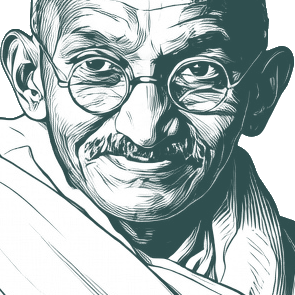
Among the many misdeeds of British rule in India, history will look upon the Act which deprived a whole nation of arms as the blackest. - Mahatma Gandhi
""
Among the many misdeeds of British rule in India, history will look upon the Act which deprived a whole nation of arms as the blackest.
Mohandas Karamchand Gandhi (2 October 1869 – 30 January 1948) was an Indian lawyer, anti-colonial nationalist and political ethicist who employed nonviolent resistance to lead the successful campaign for India's independence from British rule, and to later inspire movements for civil rights and freedom across the world. The honorific Mahātmā (Sanskrit: "great-souled", "venerable"), first applied to him in 1914 in South Africa, is now used throughout the world.
Biography information from
Wikiquote·
Portrait adapted from
Wikimedia Commons, Elliott & Fry (Public domain / CC0)
Also Known As
Native Name:
મોહનદાસ ગાંધી
Alternative Names:
M. K. Gandhi
•
Mohandas K Gandhi
•
M K Gandhi
•
Mohandas Gandhi
•
Gandhi
•
Mohandas K. Gandhi
•
Gandhiji
•
Bapuji
•
Father of the Nation
•
Bapu
•
Mahatma Mohandas Karamchand Gandhi
•
Mohandas Karamchand Gandhi
•
MK Gandhi
There is an incident which occurred at the examination during my first year at the high school and which is worth recording. Mr. Giles, the Educational Inspector, had come on a visit of inspection. He had set us five words to write as a spelling exercise. One of the words was 'kettle'. I had mis-spelt it. The teacher tried to prompt me with the point of his boot, but I would not be prompted. It was beyond me to see that he wanted me to copy the spelling from my neighbour's slate, for I had thought that the teacher was there to supervise us against copying. The result was that all the boys, except myself, were found to have spelt every word correctly. Only I had been stupid. The teacher tried later to bring this stupidity home to me, but without effect. I never could learn the art of 'copying'.
I do not wish to suggest that because we were one nation we had no differences, but it is submitted that our leading men travelled throughout India . . . They learned one another's languages . . . they saw that India was one undivided land so made by nature. They, therefore, argued that it must be one nation. Arguing thus, they established holy places in various parts of India, and fired the people with an idea of nationality in a manner unknown in other parts of the world. Any two Indians are one as no two Englishmen are.
Limited Time Offer
Premium members can get their quote collection automatically imported into their Quotewise collections.