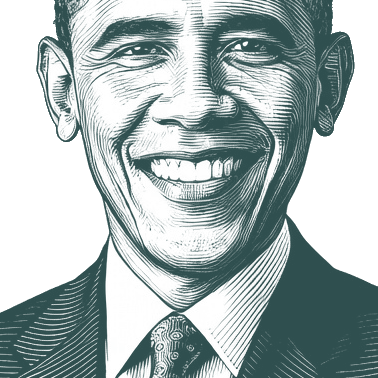
I think the trick is figuring out how do we structure government systems that pool resources and hence facilitate some redistribution because I actua… - Barack Obama
""
I think the trick is figuring out how do we structure government systems that pool resources and hence facilitate some redistribution because I actually believe in redistribution — at least at a certain level to make sure that everybody's got a shot.
English
Collect this quote
About
Barack Obama
Barack Hussein Obama II (born August 4, 1961) is an American politician who served as the 44th president of the United States of America from 2009 to 2017. Born in Hawaii, the son of a Kenyan father and a mother from Kansas, he won the 2008 presidential election and was re-elected president in November 2012. A member of the U.S. Democratic Party, he was the first African American president. Before becoming president, he represented the 13th district for three terms in the Illinois Senate from 1997 to 2004 and served as United States senator from Illinois between January 4, 2005 and November 16, 2008. While president, he was the recipient of the 2009 Nobel Peace Prize.
Biography information from
Wikiquote·
Portrait adapted from
Wikimedia Commons, Official White House Photo by Pete Souza (Public domain / CC0)
Also Known As
Birth Name:
Barack Hussein Obama II
Also Known As:Barry
Alternative Names:
POTUS 44
•
Barack Hussein Obama
•
Barack H. Obama
•
Barack Hussein Obama, Jr.
•
Barack H Obama
•
Barak Obama
•
Barry Obama
•
Barack Obama II
The U.S. military has performed valiantly and brilliantly in Iraq. Our troops have done all that we have asked them to do and more. But no amount of American soldiers can solve the political differences at the heart of somebody else's civil war, nor settle the grievances in the hearts of the combatants. It is my firm belief that the responsible course of action - for the United States, for Iraq, and for our troops - is to oppose this reckless escalation and to pursue a new policy. This policy that I've laid out is consistent with what I have advocated for well over a year, with many of the recommendations of the bipartisan Iraq Study Group, and with what the American people demanded in the November election. When it comes to the war in Iraq, the time for promises and assurances, for waiting and patience, is over. Too many lives have been lost and too many billions have been spent for us to trust the President on another tried and failed policy opposed by generals and experts, Democrats and Republicans, Americans and many of the Iraqis themselves. It is time for us to fundamentally change our policy. It is time to give Iraqis their country back. And it is time to refocus America's efforts on the challenges we face at home and the wider struggle against terror yet to be won.
Let me make one final point about the use of force. Even as we make difficult decisions about going to war, we must also think clearly about how we fight it.
Enhance Your Quote Experience
Enjoy ad-free browsing, unlimited collections, and advanced search features with Premium.
The truth is, being an American is hard. Being part of a democratic government is hard. Being a citizen is hard. It is a challenge. It’s supposed to be. There’s no respite from our ideals. All of us are called to live up to our expectations for ourselves -- not just when it’s convenient, but when it’s inconvenient. When it’s tough. When we’re afraid. The tension throughout our history between welcoming or rejecting the stranger, it’s about more than just immigration. It’s about the meaning of America, what kind of country do we want to be. It’s about the capacity of each generation to honor the creed as old as our founding: “E Pluribus Unum” -- that out of many, we are one.