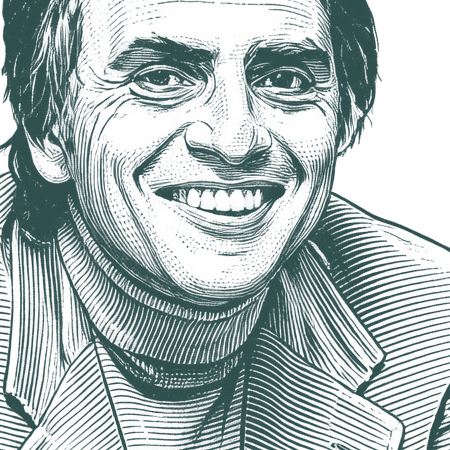
The methods and ethos of science and religion are profoundly different. Religion frequently asks us to believe without question, even (or especially)… - Carl Sagan
""
The methods and ethos of science and religion are profoundly different. Religion frequently asks us to believe without question, even (or especially) in the absence of hard evidence. Indeed, this is the central meaning of faith. Science asks us to take nothing on faith, to be wary of our penchant for self-deception, to reject anecdotal evidence. Science considers deep skepticism a prime virtue. Religion often sees it as a barrier to enlightenment. So, for centuries, there has been a conflict between the two fields—the discoveries of science challenging religious dogmas, and religion attempting to ignore or suppress the disquieting findings.
Carl Edward Sagan (9 November 1934 – 20 December 1996) was an American astronomer, planetary scientist, cosmologist, astrophysicist, astrobiologist, author, and science communicator. His best known scientific contribution is research on extraterrestrial life, including experimental demonstration of the production of amino acids from basic chemicals by radiation. Sagan assembled the first physical messages sent into space, the Pioneer plaque and the Voyager Golden Record, universal messages that could potentially be understood by any extraterrestrial intelligence that might find them. Sagan argued the hypothesis, accepted since, that the high surface temperatures of Venus can be attributed to, and calculated using, the greenhouse effect. He testified to the US Congress in 1985 that the greenhouse effect will change the earth's climate system.
Biography information from
Wikiquote·
Portrait adapted from
Wikimedia Commons, NASA/JPL (Public domain / CC0)
Also Known As
Native Name:
Carl Edward Sagan
Alternative Names:
Sagan
•
Carl E. Sagan
•
Carl E Sagan
•
C. E. Sagan
•
C.E. Sagan
•
C E Sagan
•
C. Sagan
•
C Sagan
•
Sagan C
•
Sagan C.
•
Sagan C. E.
•
Sagan CE
There is no question that religions have historically played the role of making people contented with their lot. ...such a doctrine would be very appealing to the ruling classes of a society. ...Many societies, for this reason alone, encourage the contentment with your lot that the religious premise of heaven affords.
PREMIUM FEATURE
Advanced Search Filters
Filter search results by source, date, and more with our premium search tools.
Briefly illuminated on the wall beside her desk was a quotation from the Parables of Franz Kafka: Now the Sirens have a still more fatal weapon than their song, namely their silence . . . Someone might possibly have escaped from their singing; but from their silence, certainly never.