Works in ChatGPT, Claude, or Any AI
Add semantic quote search to your AI assistant via MCP. One command setup.
" "Man must be disciplined, for he is by nature raw and wild.
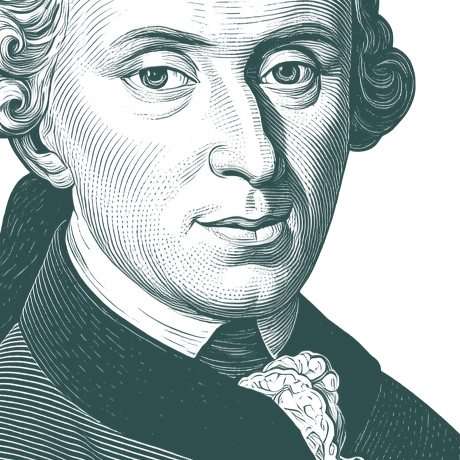
Immanuel Kant (22 April 1724 – 12 February 1804), born Emanuel Kant, was a German philosopher.
Biography information from Wikiquote
Add semantic quote search to your AI assistant via MCP. One command setup.
Related quotes. More quotes will automatically load as you scroll down, or you can use the load more buttons.
What is the use of working toward a lawful civic constitution among individuals, i.e., toward the creation of a commonwealth? The same unsociability which drives man to this causes any single commonwealth to stand in unrestricted freedom in relation to others; consequently, each of them must expect from another precisely the evil which oppressed the individuals and forced them to enter into a lawful civic state. The friction among men, the inevitable antagonism, which is a mark of even the largest societies and political bodies, is used by Nature as a means to establish a condition of quiet and security. Through war, through the taxing and never-ending accumulation of armament, through the want which any state, even in peacetime, must suffer internally, Nature forces them to make at first inadequate and tentative attempts; finally, after devastations, revolutions, and even complete exhaustion, she brings them to that which reason could have told them at the beginning and with far less sad experience, to wit, to step from the lawless condition of savages into a league of nations. In a league of nations, even the smallest state could expect security and justice, not from its own power and by its own decrees, but only from this great league of nations … from a united power acting according to decisions reached under the laws of their united will.
Add semantic quote search to your AI assistant via MCP. One command setup.
That all our knowledge begins with experience there can be no doubt. For how is it possible that the faculty of cognition should be awakened into exercise otherwise than by means of objects which affect our senses, and partly of them selves produce representations, partly rouse our powers of understanding into activity, to compare, to connect, or to separate these, and so to convert the raw material of our sensuous impressions into a knowledge of objects, which is called experience? In respect of time, therefore, no knowledge of ours is antecedent to experience, but begins with it. But though all our knowledge begins with experience, it by no means follows, that all arises out of experience. For, on the contrary, it is quite possible that our empirical knowledge is a compound of that which we receive through impressions, and that which the faculty of cognition supplies from itself (sensuous impressions giving merely the occasion)... It is, therefore, a question which requires close investigation, and is not to be answered at first sight,—whether there exists a knowledge altogether independent of experience, and even of all sensuous impressions? Knowledge of this kind is called à priori, in contradistinction to empirical knowledge which has its sources à posteriori, that is, in experience.