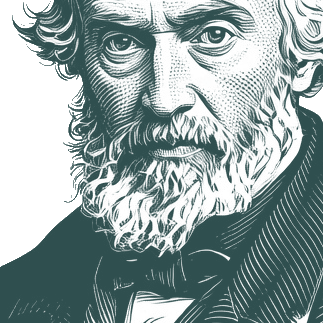
The more I reflect on it, the more I must admire how completely nature had taught him; how completely he was devoted to his work, to the task of his … - Thomas Carlyle
""
The more I reflect on it, the more I must admire how completely nature had taught him; how completely he was devoted to his work, to the task of his life, and content to let all pass by unheeded that had not relation to this. It is a singular fact, for example, that though a man of such openness and clearness, he had never, I believe, read three pages of Burns's poems. Not even when all about him became noisy and enthusiastic, I the loudest, on that matter, did he feel it worth while to renew his investigation of it, or once turn his face towards it. The poetry he liked (he did not call it poetry) was truth, and the wisdom of reality. Burns, indeed, could have done nothing for him. As high a greatness hung over his world as over that of Burns — the ever-present greatness of the Infinite itself. Neither was he, like Burns, called to rebel against the world, but to labor patiently at his task there, uniting the possible with the necessary to bring out the real, wherein also lay an ideal.
English
Collect this quote
About
Thomas Carlyle
Thomas Carlyle (December 4 1795 – February 5 1881) was a Scottish essayist, historian and philosopher of great prominence during the Victorian era. His wife was Jane Welsh Carlyle.
Biography information from
Wikiquote·
Portrait adapted from
Wikimedia Commons, Sir John Everett Millais, 1st Bt (died 1896) (Public domain / CC0)
If a soul is born with divine intelligence, and has its lips touched with hallowed fire, in consecration for high enterprises under the sun, this young soul will find the question asked of him by England every hour and moment: "Canst thou turn thy human intelligence into the beaver sort, and make honest contrivance, and accumulation of capital by it? If so, do it; and avoid the vulpine kind, which I don't recommend. Honest triumphs in engineering and machinery await thee; scrip awaits thee, commercial successes, kingship in the counting-room, on the stock-exchange;—thou shalt be the envy of surrounding flunkies, and collect into a heap more gold than a dray-horse can draw. "—"Gold, so much gold?" answers the ingenuous soul, with visions of the envy of surrounding flunkies dawning on him; and in very many cases decides that he will contract himself into beaverism, and with such a horse-draught of gold, emblem of a never-imagined success in beaver heroism, strike the surrounding flunkies yellow. This is our common course; this is in some sort open to every creature, what we call the beaver career; perhaps more open in England, taking in America too, than it ever was in any country before. And, truly, good consequences follow out of it: who can be blind to them? Half of a most excellent and opulent result is realized to us in this way; baleful only when it sets up (as too often now) for being the whole result.
Thirty millions, mostly fools.
Reported as his reply when asked the population of England. The framing rests on Samuel Arthur Bent's Familiar Short Sayings of Great Men (1882); Carlyle's own written form reads 'twenty-seven millions mostly fools', and tellings vary between twenty and thirty.
Works in ChatGPT, Claude, or Any AI
Add semantic quote search to your AI assistant via MCP. One command setup.
Transport yourselves into the early childhood of nations; the first beautiful morning-light of our Europe, when all yet lay in fresh young radiance as of a great sunrise, and our Europe was first beginning to think, to be! Wonder, hope; infinite radiance of hope and wonder, as of a young child's thoughts, in the hearts of these strong men! Strong sons of Nature; and here was not only a wild Captain and Fighter; discerning with his wild flashing eyes what to do, with his wild lion-heart daring and doing it; but a Poet too, all that we mean by a Poet, Prophet, great devout Thinker and Inventor,—as the truly Great Man ever is. A Hero is a Hero at all points; in the soul and thought of him first of all. This Odin, in his rude semi-articulate way, had a word to speak. A great heart laid open to take in this great Universe, and man's Life here, and utter a great word about it. A Hero, as I say, in his own rude manner; a wise, gifted, noble-hearted man. And now, if we still admire such a man beyond all others, what must these wild Norse souls, first awakened into thinking, have made of him!