The cosmos was discovered only yesterday.
For a million years it was clear to everyone that there were no other places than the earth.
Then in the … - Carl Sagan
""
The cosmos was discovered only yesterday.
For a million years it was clear to everyone that there were no other places than the earth.
Then in the last tenth of a percent of the lifetime of our species, in the instant between Aristarchus and ourselves, we reluctantly noticed that we were not the centre and purpose of the universe,
but rather lived on a tiny and fragile world lost in immensity and eternity, drifting in a great cosmic ocean dotted here and there with a hundred billion galaxies and a billion trillion stars.
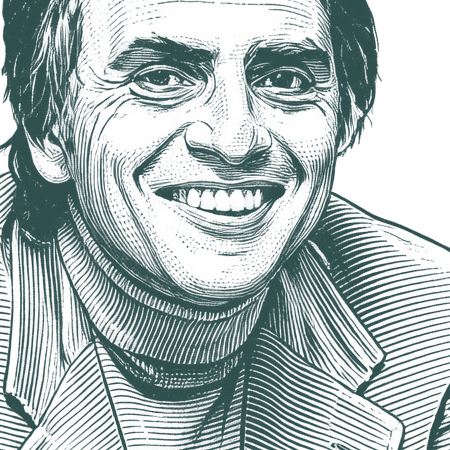
Carl Edward Sagan (9 November 1934 – 20 December 1996) was an American astronomer, planetary scientist, cosmologist, astrophysicist, astrobiologist, author, and science communicator. His best known scientific contribution is research on extraterrestrial life, including experimental demonstration of the production of amino acids from basic chemicals by radiation. Sagan assembled the first physical messages sent into space, the Pioneer plaque and the Voyager Golden Record, universal messages that could potentially be understood by any extraterrestrial intelligence that might find them. Sagan argued the hypothesis, accepted since, that the high surface temperatures of Venus can be attributed to, and calculated using, the greenhouse effect. He testified to the US Congress in 1985 that the greenhouse effect will change the earth's climate system.
Biography information from
Wikiquote·
Portrait adapted from
Wikimedia Commons, NASA/JPL (Public domain / CC0)
Also Known As
Native Name:
Carl Edward Sagan
Alternative Names:
Sagan
•
Carl E. Sagan
•
Carl E Sagan
•
C. E. Sagan
•
C.E. Sagan
•
C E Sagan
•
C. Sagan
•
C Sagan
•
Sagan C
•
Sagan C.
•
Sagan C. E.
•
Sagan CE
Human history can be viewed as a slowly dawning awareness that we are members of a larger group. Initially our loyalties were to ourselves and our immediate family, next, to bands of wandering hunter-gatherers, then to tribes, small settlements, city-states, nations. We have broadened the circle of those we love. We have now organized what are modestly described as super-powers, which include groups of people from divergent ethnic and cultural backgrounds working in some sense together — surely a humanizing and character building experience. If we are to survive, our loyalties must be broadened further, to include the whole human community, the entire planet Earth. Many of those who run the nations will find this idea unpleasant. They will fear the loss of power. We will hear much about treason and disloyalty. Rich nation-states will have to share their wealth with poor ones. But the choice, as H. G. Wells once said in a different context, is clearly the universe or nothing.
"It is conventional wisdom now that anything built by the government will be a disaster. But the two "Voyager" spacecraft were built by the government (in partnership with that other bugaboo, academia). They came in at cost, on time, and vastly exceeded their design specifications — as well as the fondest dreams of their makers. Seeking not to control, threaten, wound, or destroy, these elegant machines represented the exploratory part of our nature set free to roam the Solar System and beyond. This kind of technology, the treasures it uncovers freely available to all humans everywhere, has been, over the last few decades, one of the few activities of the United States admired as much by those who abhor many of its policies as by those who agree with it on every issue. "Voyager" cost each American less than a penny a year from launch to Neptune encounter. Missions to the planets are one of those things — and I mean this not just for the United States, but for the human species — that we do best."
PREMIUM FEATURE
Advanced Search Filters
Filter search results by source, date, and more with our premium search tools.