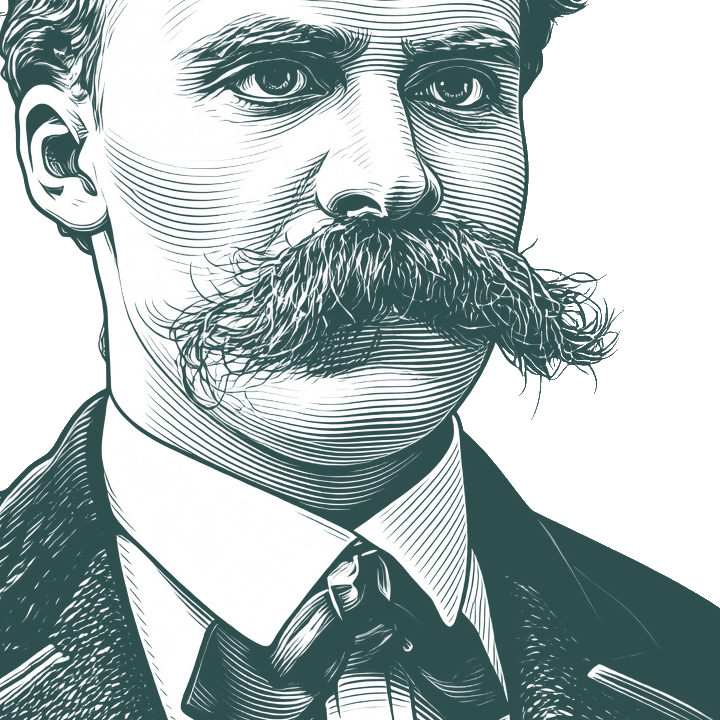
Without cruelty there is no festival: thus the longest and most ancient part of human history teaches — and in punishment there is so much that is fe… - Friedrich Nietzsche
""
Without cruelty there is no festival: thus the longest and most ancient part of human history teaches — and in punishment there is so much that is festive!
English
Collect this quote
About
Friedrich Nietzsche
Friedrich Wilhelm Nietzsche (15 October 1844 – 25 August 1900) was a German philosopher, cultural critic, composer, poet, writer, and philologist whose work has exerted a profound influence on modern intellectual history. His critiques of contemporary culture, religion, and philosophy centered on a basic question regarding the foundation of values and morality.
Biography information from
Wikiquote·
Portrait adapted from
Wikimedia Commons, Friedrich Hermann Hartmann (Public domain / CC0)
Also Known As
Alternative Names:
Friedrich Wilhelm Nietzsche
•
Nietzsche
In solitude the solitary man consumes himself, in the crowd the crowd consumes him.
Examine the lives of the best and more fruitful men and peoples, and ask yourselves whether a tree, if it is to grow proudly into the sky, can do without bad weather and storms: whether unkindness and opposition from without, whether some sort of hatred, envy, obstinacy, mistrust, severity, greed and violence do not belong to the favouring circumstances without which a great increase even in virtue is hardly possible. The poison which destroys the weaker nature strengthens the stronger – and he does not call it poison, either.
Limited Time Offer
Premium members can get their quote collection automatically imported into their Quotewise collections.
Artists have an interest in … so-called inspirations; as if the idea of a work of art, of poetry, the fundamental thought of a philosophy shines down like a merciful light from heaven.
In truth, the good artist's or thinker's imagination is continually producing things good, mediocre, and bad, but his power of judgment, highly sharpened and practiced, rejects, selects, joins together; thus we now see from Beethoven's notebooks that he gradually assembled the most glorious melodies and, to a degree, selected them out of disparate beginnings.
The artist who separates less rigorously, liking to rely on his imitative memory, can in some circumstances become a great improviser; but artistic improvisation stands low in relation to artistic thoughts earnestly and laboriously chosen. All great men were great workers, untiring not only in invention but also in rejecting, sifting, reforming, arranging.