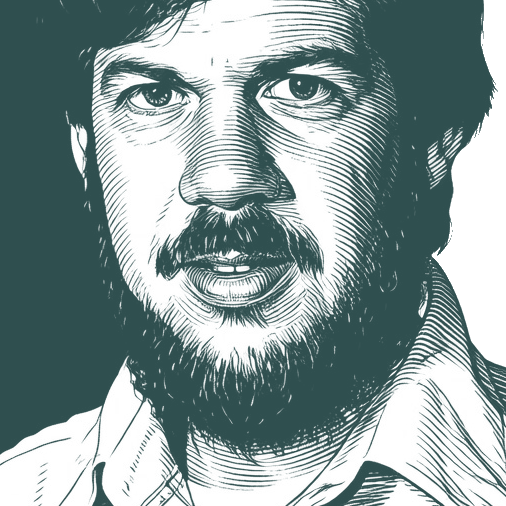
We can now determine, easily and relatively cheaply, the detailed chemical architecture of genes; and we can trace the products of these genes (enzym… - Stephen Jay Gould
""
We can now determine, easily and relatively cheaply, the detailed chemical architecture of genes; and we can trace the products of these genes (enzymes and proteins) as they influence the course of embryology. In so doing we have made the astounding discovery that all complex animal phyla - arthropods and vertebrates in particular - have retained, despite their half-billion years of evolutionary independence, an extensive set of common genetic blueprints for building bodies.
English
Collect this quote
About
Stephen Jay Gould
Stephen Jay Gould (September 10, 1941 – May 20, 2002) was an American geologist, paleontologist, evolutionary biologist and popular-science author, who spent most of his career teaching at Harvard University and working at the American Museum of Natural History in New York. He was one of the most influential and widely read writers of popular science of his generation.
Biography information from
Wikiquote·
Portrait adapted from
Wikimedia Commons, Lawrence Lipke (Public domain / CC0)
Antiessentialist thinking forces us to view the world differently. We must accept shadings and continua as fundamental. We lose criteria for judgment by comparison to some ideal: short people, retarded people, people of other beliefs, colors, and religions are people of full status.
We do not inhabit a perfected world where natural selection ruthlessly scrutinizes all organic structures and then molds them for optimal utility. Organisms inherit a body form and a style of embryonic development; these impose constraints upon future change and adaptation. In many cases, evolutionary pathways reflect inherited patterns more than current environmental demands. These inheritances constrain, but they also provide opportunity. A potentially minor genetic change […] entails a host of complex, nonadaptive consequences. The primary flexibility of evolution may arise from nonadaptive by-products that occasionally permit organisms to strike out in new and unpredictable directions. What “play” would evolution have if each structure were built for a restricted purpose and could be used for nothing else? How could humans learn to write if our brain had not evolved for hunting, social cohesion, or whatever, and could not transcend the adaptive boundaries of its original purpose?
Consider the magnitude of this... Taxonomists have described almost a million species of arthropods, and all fit into four major groups; one quarry in British Columbia, representing the first explosion of multicellular life, reveals more than twenty additional arthropod designs!