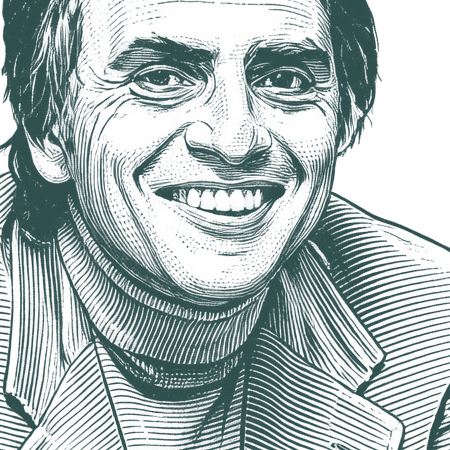
unlike the American university standard of today — teachers were valued for their teaching, their ability to inform and inspire the next generation. - Carl Sagan
""
unlike the American university standard of today — teachers were valued for their teaching, their ability to inform and inspire the next generation.
Collect this quote
About
Carl Sagan
Carl Edward Sagan (9 November 1934 – 20 December 1996) was an American astronomer, planetary scientist, cosmologist, astrophysicist, astrobiologist, author, and science communicator. His best known scientific contribution is research on extraterrestrial life, including experimental demonstration of the production of amino acids from basic chemicals by radiation. Sagan assembled the first physical messages sent into space, the Pioneer plaque and the Voyager Golden Record, universal messages that could potentially be understood by any extraterrestrial intelligence that might find them. Sagan argued the hypothesis, accepted since, that the high surface temperatures of Venus can be attributed to, and calculated using, the greenhouse effect. He testified to the US Congress in 1985 that the greenhouse effect will change the earth's climate system.
Biography information from
Wikiquote·
Portrait adapted from
Wikimedia Commons, NASA/JPL (Public domain / CC0)
Also Known As
Native Name:
Carl Edward Sagan
Alternative Names:
Sagan
•
Carl E. Sagan
•
Carl E Sagan
•
C. E. Sagan
•
C.E. Sagan
•
C E Sagan
•
C. Sagan
•
C Sagan
•
Sagan C
•
Sagan C.
•
Sagan C. E.
•
Sagan CE
As a consequence of the enormous social and technological changes of the last few centuries, the world is not working well. We do not live in traditional and static societies. But our government, in resisting change, act as if we did. Unless we destroy ourselves utterly, the future belongs to those societies that, while not ignoring the reptilian and mammalian parts of our being, enable the characteristically human components of our nature to flourish; to those societies that encourage diversity rather than conformity; to those societies willing to invest resources in a variety of social, political, economic and cultural experiments, and prepared to sacrifice short-term advantage for long-term benefit; to those societies that treat new ideas as delicate, fragile and immensely valuable pathways to the future.