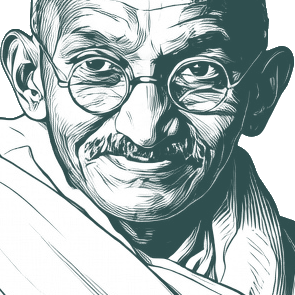
If you want to give a message again to the West, it must be a message of 'Love', it must be a message of 'Truth'. There must be a conquest — [audienc… - Mahatma Gandhi
""
If you want to give a message again to the West, it must be a message of 'Love', it must be a message of 'Truth'. There must be a conquest — [audience claps] — please, please, please. That will interfere with my speech, and that will interfere with your understanding also. I want to capture your hearts and don't want to receive your claps. Let your hearts clap in unison with what I'm saying, and I think, I shall have finished my work. Therefore, I want you to go away with the thought that Asia has to conquer the West. Then, the question that a friend asked yesterday, "Did I believe in one world?" Of course, I believe in one world. And how can I possibly do otherwise, when I become an inheritor of the message of love that these great un-conquerable teachers left for us? You can redeliver that message now, in this age of democracy, in the age of awakening of the poorest of the poor, you can redeliver this message with the greatest emphasis.
Mohandas Karamchand Gandhi (2 October 1869 – 30 January 1948) was an Indian lawyer, anti-colonial nationalist and political ethicist who employed nonviolent resistance to lead the successful campaign for India's independence from British rule, and to later inspire movements for civil rights and freedom across the world. The honorific Mahātmā (Sanskrit: "great-souled", "venerable"), first applied to him in 1914 in South Africa, is now used throughout the world.
Biography information from
Wikiquote·
Portrait adapted from
Wikimedia Commons, Elliott & Fry (Public domain / CC0)
Also Known As
Native Name:
મોહનદાસ ગાંધી
Alternative Names:
M. K. Gandhi
•
Mohandas K Gandhi
•
M K Gandhi
•
Mohandas Gandhi
•
Gandhi
•
Mohandas K. Gandhi
•
Gandhiji
•
Bapuji
•
Father of the Nation
•
Bapu
•
Mahatma Mohandas Karamchand Gandhi
•
Mohandas Karamchand Gandhi
•
MK Gandhi
I say without fear of my figures being successfully challenged that India today is more illiterate than it was before a fifty or hundred years ago, and so is Burma, because the British administrators when they came to India, instead of taking hold of things as they were, began to root them out. They scratched the soil and began to look at the root and left the root like that and the beautiful tree perished.
A nation of three hundred million people should be ashamed to have to resort to force to bring to book one hundred thousand Englishmen. To convert them, or, if you will, even to drive them out of the country, we need, not force of arms, but force of will. If we have not the latter, we shall never get the former. If we develop the force of will, we shall find that we do not need the force of arms. Acceptance of non-violence, therefore, for the purposes mentioned by me, is the most natural and the most necessary condition of our national existence. It will teach us to husband our corporate physical strength for a better purpose, instead of dissipating it, as now, in a useless fratricidal strife, in which each party is exhausted after the effort. And every armed rebellion must be an insane act unless it is backed by the nation. But almost any item of non-cooperation fully backed by the nation can achieve the aim without shedding a single drop of blood. I do not say 'eschew violence in your dealing with robbers or thieves or with nations that may invade India.' But in order that we are better able to do so, we must learn to restrain ourselves. It is a sign not of strength but of weakness to take up the pistol on the slightest pretext. Mutual fisticuffs are a training not in violence but in emasculation. My method of non-violence can never lead to loss of strength, but it alone will make it possible, if the nation wills it, to offer disciplined and concerted violence in time of danger.
Enhance Your Quote Experience
Enjoy ad-free browsing, unlimited collections, and advanced search features with Premium.
During my travels, I find a general belief that to turn a Christian is to turn European; to become self-willed, and give up self-restraint, use only foreign cloth, dress oneself in European style and start taking meat and brandy. But I think the fact is, if a person discards his country, his customs and his old connections and manners when he changes his religion, he becomes all the more unfit to gain a knowledge of God. For, a change of religion means really a conversion of the heart. When there is a real conversion, a man's heart grows. But in this country one finds that conversion brings about deep disdain for one's old religion and its followers, i.e., one's old friends and relatives. The next change that takes place is that of dress and manners and behaviour. All that does great harm to the country.