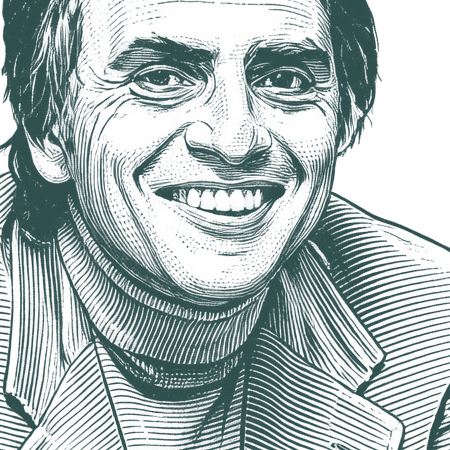
More recently, books, especially paperbacks, have been printed in massive and inexpensive editions. For the price of a modest meal you can ponder the… - Carl Sagan
""
More recently, books, especially paperbacks, have been printed in massive and inexpensive editions. For the price of a modest meal you can ponder the decline and fall of the Roman Empire, the origin of species, the interpretation of dreams, the nature of things. Books are like seeds. They can lie dormant for centuries and then flower in the most unpromising soil.
Carl Edward Sagan (9 November 1934 – 20 December 1996) was an American astronomer, planetary scientist, cosmologist, astrophysicist, astrobiologist, author, and science communicator. His best known scientific contribution is research on extraterrestrial life, including experimental demonstration of the production of amino acids from basic chemicals by radiation. Sagan assembled the first physical messages sent into space, the Pioneer plaque and the Voyager Golden Record, universal messages that could potentially be understood by any extraterrestrial intelligence that might find them. Sagan argued the hypothesis, accepted since, that the high surface temperatures of Venus can be attributed to, and calculated using, the greenhouse effect. He testified to the US Congress in 1985 that the greenhouse effect will change the earth's climate system.
Biography information from
Wikiquote·
Portrait adapted from
Wikimedia Commons, NASA/JPL (Public domain / CC0)
Also Known As
Native Name:
Carl Edward Sagan
Alternative Names:
Sagan
•
Carl E. Sagan
•
Carl E Sagan
•
C. E. Sagan
•
C.E. Sagan
•
C E Sagan
•
C. Sagan
•
C Sagan
•
Sagan C
•
Sagan C.
•
Sagan C. E.
•
Sagan CE
Related quotes. More quotes will automatically load as you scroll down, or you can use the load more buttons.
Shorter versions of this quote
Books are like seeds. They can lie dormant for centuries and then flower in the most unpromising soil.
For the price of a modest meal you can ponder the decline and fall of the Roman Empire, the origin of species, the interpretation of dreams, the nature of things. Books are like seeds. They can lie dormant for centuries and then flower in the most unpromising soil.
Are we willing to tolerate ignorance and complacency in matters that affect the entire human family?
There is a wide yawning black infinity. In every direction the extension is endless, the sensation of depth is overwhelming. And the darkness is immortal. Where light exists, it is pure, blazing, fierce; but light exists almost nowhere, and the blackness itself is also pure and blazing and fierce. But most of all, there is very nearly nothing in the dark; except for little bits here and there, often associated with the light, this infinite receptacle is empty.
This picture is strangely frightening. It should be familiar. It is our universe.
Even these stars, which seem so numerous, are, as sand, as dust, or less than dust, in the enormity of the space in which there is nothing. Nothing! We are not without empathetic terror when we open Pascal’s Pensées and read, 'I am the great silent spaces between worlds.'
[From an undated, handwritten piece of text from the early 1950s which Sagan wrote when he was an undergraduate at the University of Chicago]
PREMIUM FEATURE
Advanced Search Filters
Filter search results by source, date, and more with our premium search tools.
Had your spacecraft flown by the Earth a hundred million years ago, in the age of the dinosaurs when there were no humans and no technology, you would still have seen oxygen and ozone, the chlorophyll pigment, and far too much methane. At present, though, your instruments are finding signs not just of life, but of high technology — something that couldn’t possibly have been detected even a hundred years ago: You are detecting a particular kind of radio wave emanating from Earth. Radio waves don’t necessarily signify life and intelligence. Many natural processes generate them. You’ve already found radio emissions from other, apparently uninhabited worlds — generated by electrons trapped in the strong magnetic fields of planets, by chaotic motions at the shock front that separates these magnetic fields from the interplanetary magnetic field, and by lightning.