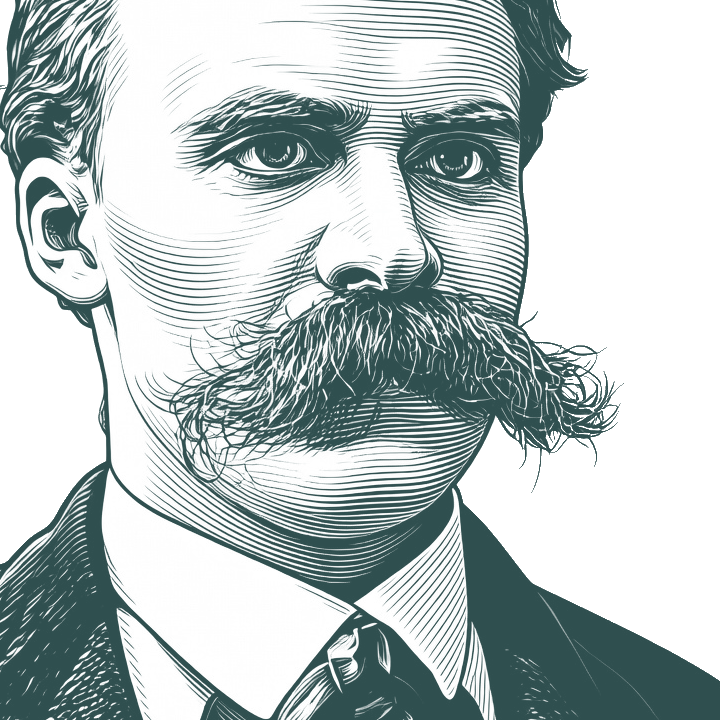
There is a false saying, ‘Whoever cannot save himself - how can he save others?’ But if I have the key to your chains, why should your and my lock be… - Friedrich Nietzsche
""
There is a false saying, ‘Whoever cannot save himself - how can he save others?’ But if I have the key to your chains, why should your and my lock be the same.
Friedrich Wilhelm Nietzsche (15 October 1844 – 25 August 1900) was a German philosopher, cultural critic, composer, poet, writer, and philologist whose work has exerted a profound influence on modern intellectual history. His critiques of contemporary culture, religion, and philosophy centered on a basic question regarding the foundation of values and morality.
Biography information from
Wikiquote·
Portrait adapted from
Wikimedia Commons, Friedrich Hermann Hartmann (Public domain / CC0)
Also Known As
Alternative Names:
Friedrich Wilhelm Nietzsche
•
Nietzsche
Every moment of life wants to tell us something, but we do not want to hear what it has to say: when we are alone and quiet we are afraid that something will be whispered into our ear and hence we despise quiet and drug ourselves with sociability.
I say unto you: one must still have chaos in oneself to be able to give birth to a dancing star. I say unto you: you still have chaos in yourselves. *** Where is the lightning to lick you with its tongue. Where is the frenzy with which you should be inoculated. Behold. I give you the Ubermensch. He is this lightning. He is this frenzy.
Unlimited Quote Collections
Organize your favorite quotes without limits. Create themed collections for every occasion with Premium.
You have committed one of the greatest stupidities — for yourself and for me! Your association with an anti-Semitic chief expresses a foreignness to my whole way of life which fills me again and again with ire or melancholy. ... It is a matter of honor with me to be absolutely clean and unequivocal in relation to anti-Semitism, namely, opposed to it, as I am in my writings. I have recently been persecuted with letters and Anti-Semitic Correspondence Sheets. My disgust with this party (which would like the benefit of my name only too well!) is as pronounced as possible, but the relation to Förster, as well as the aftereffects of my former publisher, the anti-Semitic Schmeitzner, always brings the adherents of this disagreeable party back to the idea that I must belong to them after all. ... It arouses mistrust against my character, as if publicly I condemned something which I have favored secretly — and that I am unable to do anything against it, that the name of Zarathustra is used in every Anti-Semitic Correspondence Sheet, has almost made me sick several times.